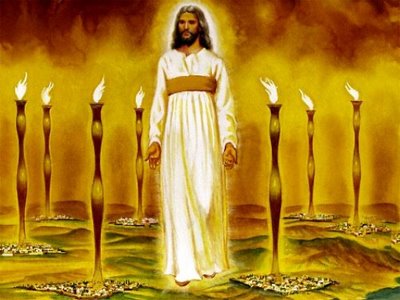
Revelation 1:4 “…and from the seven Spirits which are before his throne,…”
Revelation 4:5 gives more commentary on these Spirits which associate them with the seven lamps: “… And there were seven lamps of fire burning before the throne, which are the seven Spirits of God.” The concept of the “seven spirits” of God is a common theme in the book of Revelation (3:1; 4:5; 5:6). We are told in Ephesians 4:4, however, that there is, but, ONE Spirit in relation to God. Then there is John 4:24, which defines God as “Spirit.” Therefore, God is, but, ONE Spirit, in the strictest manner of speaking. Yet, here, we are told that God has “seven Spirits.” Because of the nature of apocalyptic literature, we know that the “seven Spirits” of God must be understood in the light of symbolic language. The reader of Revelation is informed that the language of the manuscript is symbolic; in Revelation 1:1, he is told that the Revelation would be shown to John by significations (esēmanen). Since seven (7) is the biblical number of completion, the Spirit of God is presented in the Apocalypse as seven attributes of one complete, and total, Holy Spirit.Furthermore, the passage, here, is an echo of Zechariah 4:2-10 (a reference to the Lampstand of the tabernacle), where the prophet Zechariah saw the seven Spirits of God as seven lamps (4:5).
The Seven Spirits of God Are These:
1. The Spirit of Wisdom and Understanding ................Isaiah 11:2
2. The Spirit of Council and Might ...............................Isaiah 11:2
3. The Spirit of Knowledge andFear of the LORD ....Isaiah 11:2
4. The Spirit of Judgment ....................................Isaiah 4:4; 28:26
5. The Spirit of Truth .....................John 14:17; 15:26; 1 John 4:7
6. The Spirit of Faith ....................................... 2 Corinthians 4:13
7. The Spirit of Life ...............................................Revelation 11:11
When rightly divided, the Word of Truth demonstrates the “seven Spirits” of God to be, in fact, seven attributes of the Holy Spirit. The number seven symbolizes fullness, completeness, and/or perfection.One could, and probably should, speak of the sevenfold Spirit of God that is personified in the person of the Incarnate God. In point of fact, it is none other than Jesus Himself, that announces that it is He, Himself, who has the Seven Spirits of God (Rev 3:1). Paul writes it very well, “For in him dwelleth all the fulness of the Godhead bodily.And ye are complete in him, which is the head of all principality and power:” Colossians 2:9-10 Apostolically Speaking ☩☩ Jerry L Hayes
Be sure to listen and subscribe to the Bishop's Podcast: Apostolic Bishop, at:
Estimated reading time: 11.5 minutes. Christians, around the world, gather on the first day of each week to worship God and celebrate the holy Eucharist. We do this because we have been so taught by Christ and His apostles and encouraged to perpetuate the practice by our bishops since the very beginning.
It may appear that the first written record the New Testament gives for a Christian fixed day of worship is the Acts of the Apostles, written by the Evangelist Luke, where he introduces the believers at Troas meeting on the first day of the week to keep the Eucharist (Acts 20:6-7). This event would have taken place in the spring of AD 58, during Paul’s third missionary journey. However, that would be incorrect, because Paul instructed the church at Corinth, three years earlier (AD 55), to bring their offerings for the poor saints of Jerusalem each first day of the week, so there would be no need for collections when he came to them (1 Corinthians 16:2). The idea communicated here is: at each of their weekly meetings. We see, then, the Christians’ fixed time for corporate worship was The First Day of the Week.
There is witness from secular sources of this day of corporate worship in the regions of Troas and Asia in the person of Pliny’s letter to Trajan (Epp.x. 96), in which he describes the Christians as meeting on “a fixed day,” for what he calls a sacramentum (the Syriac understanding of “beaking bread” is seen by them translating it, "to break the eucharist”; the Arabic version, "to distribute the body of Christ.”) at break of day, and again in the evening to partake of a simple and innocent repast (the love feast).
This was Paul’s third visit to Troas. Who was the first pastor or bishop of the church at Troas is not certain; perhaps Carpus, of whom mention is made in 2 Timothy 4:13. At the end of the first and the beginning of the second centuries, in the times of Ignatius, there were brethren at Troas, from whence he wrote his epistles to the churches at Smyrna, and Philadelphia, and who are saluted in them by the brethren at Troas; in the third century, several martyrs suffered here, as Andreas, Paulus, Nicomachus, and Dionysia a virgin: in the "fifth" century, Pionius, bishop of Troas, was present at Constantinople at the condemnation of Eutyches, and afterwards he was in the council at Chalcedon; and even in the "eighth" century mention is made of Eustathius, bishop of Troas, in the Nicene council. My point for mentioning these things is to underline the richness of Troas’ contribution to early Christianity.
Luke writes that the Christians at Troas met on the first day of the week to celebrate the Eucharist; as has been stated, this was the spring of AD 58. We know that this was the “fixed day” appointed for their corporate worship because Paul’s party arrived on the second day of the week (Monday) and tarried until the Christians of that place came together to break bread, a full six days later; then they departed on the seventh day [Acts 20:6]—Monday.
One would be amiss, however, to assume that Sunday worship was 25-28 years (the time from Pentecost AD 30 to Paul’s instructions to the Corinthians, and/or his third visit to Troas, AD 58) in being established. Holy Scripture gives a clear picture that it was Christ, Himself, that established a first day of the week gathering for His followers by inaugurating the rhythm of days through His post resurrection appearances to His disciples. John records the two, first day of the week, gatherings of the disciples in Jerusalem, where Christ appeared in their midst (John 20:19 and 26 respectively). The first appearance was the day of the resurrection (Thomas was absent), the second was “after eight days” (Thomas was present). Actually, according to our method of counting, it would be seven days - not eight. The Jews considered any part of a day as one day. Whereas, we would not count one day until the next day, not so with the Jew. The first day, i,e, that Sunday of the first appearance is counted as day one; so, then, counting Sunday as day one and Monday as day two, the following Sunday would be day eight. That is, on the octave of the first appearance to them. The phrase “after eight days” means after the eighth day had arrived. (Understanding this type of reckoning time helps the Bible reader to grasp how Jesus was actually in the grave three days between Friday afternoon and Sunday morning.)
Let me make a few comments on the idea of the “Octave”: an 8-day period of observances beginning with a festival day.An “octave” is a musical interval embracing eight diatonic degrees; the harmonic combination of two tones an octave apart. Therefore, we may speak of the harmonics of true worship, set in motion by the first Day of the Week meetings. Thus, true worship is based on the octave of the resurrection. Only this is harmonically Christian; only this is in tune with the resurrection. A 7th day sabbath worship produces a cacophony to the orthodox octave established by Christ.
The First Day of the Week was established by the Holy Spirit throughout the holy Scriptures as being a very special day in Yahweh’s accounting of time. Two of Israel’s appointed times, Feast of First Fruits and Feast of Weeks (Pentecost), always occur on the First Day of the Week and are, themselves, Sabbaths. A third, the Feast of Tabernacles (Booths) terminates with a special Sabbath that always falls on the 8th day. (Later we will see how the fulfillment of these Old Covenant figures necessitates a First Day of the Week time of worship for saints of the New Covenant.)
We see, then, how the Old Covenant First Day of the Week events presaged the New Covenant’s fulfillment of former types and shadows; namely, the resurrection of the Savior on the very day of the Feast of First Fruits and the birth of the Lord’s Church on the very day of the Feast of Weeks (Pentecost) AD 30: Matthew 28:1; Mark 16:2, 9; Luke 24:1; John 20:1; cf. 20:19.Both were First Day of the Week Sabbaths. One should not, then, think it a strange thing for the Lord’s church to have as its day of primary worship the First Day of the Week.
Historians find the practice of the First Day of the Week worship among Christians as being universal from the beginning, with no hint of controversy; unlike, for example, the related Quartodeciman controversy. Quartodecimanism (from the VulgateLatinquarta decima inLeviticus 23:5, meaning fourteenth) refers to the custom of earlyChristians celebrating Passover beginning with the eve of the 14th day ofNisan. The Quartodeciman controversy arose because Christians in thechurches of Jerusalem andAsia Minor observed the death and resurrection on the 14th of the first month (Nisan (postexilic), Aviv/Abib (preexilic)) no matter the day of the week on which it occurred, while the churches in and around Rome changed to the practice of celebrating the resurrection on the Sunday following Nisan 14, calling it “the day of the resurrection of our Saviour.” This was more correct because the resurrection took place on the feast of first Fruits. First Fruits always occurred on the Sunday that came within the week of Unleavened Bread. So, the Sunday following the 14th of Nisan was correct.
One would reason that since the controversy over which day to celebrate the death and resurrection of Christ is so famously recorded, that a controversy over which day for Christians to meet in corporate worship could not have gone unnoticed. As is true with rejection of infant water baptism, the same is true with the rejection of Sunday worship among Christians: neither can be found before the appearance of the Anabaptists in central Europe. This is true in spite of how much this element wishes to rattle its chains back to the time of the apostles.
One hears much noise from seventh day Christians about Rome’s influence in changing the day of worship. Of course, this is just so much nonsense. In the 2nd. 3rd, or even 4th centuries the church of Rome lacked jurisdictional authority to impose a novel universal change of Sabbath rest from the seventh day to the first, or to obtain universal Sunday worship, had it, in fact, been introduced AFTER the Christian church had spread throughout the known world — as our opponents assert. R. J. Bauckham (1982, "Sabbath and Sunday in the Post-Apostolic Church” Don A. Carson (ed.). From Sabbath to Lord's Day, With & Stock Publishers/Zondervan. Pp. 252 98. ISBN 9781579103071 ) states that there is no record of any early Christian group which did not observe Sunday, with the exception of a single extreme group of Ebionites mentioned by Eusebius of Caesarea (who, among other blasphemies, denied the virgin birth and deity of our Savior - along with considering Paul as a false apostle); and that there is no evidence of Christians worshipping on the seventh day sabbath and then substituting Sunday for the sabbath in the early centuries.
It is true that on March 7th AD 321 the Roman Emperor Constantine passed a law making dies Solis, or “the day of the sun” (Sunday) a day of rest from most labor. Constantine had already begun the gears of government moving in favor of the Christians. Eight years earlier, AD 313 in the Edict of Milan he had proclaimed that citizens should be allowed to practice the religion of their choice, and specifically banned the subjugation of Christian worshippers. The Romans already had a high opinion of Sunday and the fact that Christians’ revered it, from the first, as their holy day of the week, Constantine was assured that his new law would meet with popular acceptance. One must not think, however, that the Roman law changed the day of worship for the Christians. It only made the, already,established Christian Sabbath a legal day of rest.
Correcting A Misunderstanding
Before we move from the consideration of The First Day of the Week, we should consider the misunderstanding and misinformation propagated among that segment of Christians who wish to keep the Jewish Sabbath, but lack an understanding of the biblical languages. When such ones review the Greek text for Acts 20:7 they see:
“and on the one of the sabbath (Grk. sabbatōn) they having been assembled [to] bread bread.”
From this the unlearned declare that it was not The First Day of the Week, but the first Sabbath from unleavened bread.
What one sees is a Koine Greek idiom where “sabbath” (σαββάτων [sabbatōn] Acts 20:7) is used for week. The cardinal numeral “μιᾷ” (mia) “one” is used here for the ordinal prōtē “first.” The definite article “τῇ” (tê) before the cardinal numeral “μιᾷ” (mia) makes this clear. Literially: “the one of the week.”. (See A.T. Robertson Grammar, p 671.)
Truly, the fact that, literally, every accepted English version of this text renders “Ἐν δὲ τῇ μιᾷ τῶν σαββάτων” as “on the first day of the week” should lay heavy on their minds. This demonstrates that all scholarship is in agreement on this understanding.
New King James: “Now on the first day of the week, …"
New International Version: “On the first day of the week, …"
New American Standard Bible: “On the first day of the week, …”
Revised Standard Version: “On the first day of the week, …"
New Living Translation: “On the first day of the week, …"
Young’s Literal Translation: “On the first day of the week, …"
Here I have given three texts where σαββάτων or σαββάτου (i.e. “sabbath”) is used as an idiom for “week.”
Acts 20:7
En de tē miai tōn sabbatōn
And-on the one (first) of the week
Mark 16:9
Anastas de prōi prōtē sabbatou)
And-having arisen early on [the] first [day] of the week
1 Cor 16:2
kata mian sabbatou)
every first [day] of a week …
In Word Studies in the New Testament, M.R. Vincent says, "The noun "Sabbath" is often used after numerals in the signification of a week.”
The Greek sabbaton (σαββάτων), or sabbatou. (σαββάτου) is never translated as “the Sabbath day” in these passages. the word is used in these contexts (as Greek scholars overwhelmingly agree) to denote a “week” (Perschbacher, 1990, p. 364), “a period of seven days” (Danker, et al., 2000, p. 910; cf. Thayer, 1962, p. 566).
John Lightfoot states: “The Jews reckon the days of the week thus; One\ (or the first day) of the sabbath: two (or the second day) of the sabbath;” etc. (1859).
Apologia is a polemical work in the defense of Christian sacred days. Our focus is Sunday worship, Easter and Christmas. Since the rise of the Anabaptist movement of the 16th century a 7th day sabbath element has existed in the Christian faith. There has been little written in the line of a strong apologia for the observance to the traditional times. Bishop Hayes offers his work "Apologia, A Defense of Christian Sacred Days" to meet that need. This book establishes why Christians have observed Sunday as their primary day of worship right out of the gate. Also, within the pages of "Apologia" the reader will discover the true meaning of the terms 'Easter" and "Christmas". Bishop Jerry L Hayes comes to the defense of historical Christianity in this work that is destined to become a classic.
Estimated reading time: 20 minutes. Christianity is a relationship with the Almighty. In that sense it stands apart from all other religions of the earth. Further, it is relationship which moves Christianity beyond the ground of mere religion. The sacred scriptures of our faith introduce the Creator God as “Father.” This cognomen of the Deity speaks to us of a particular relationship. By contrast: of Islam’s 99 touted names of Allah, not one of them is “Father.”
At the very foundation of the relationship between Christians and their Creator is the inviolable covenant brought into effect by the death of its Testator.
Yahweh, speaking through the prophet Jeremiah, foretold of this great covenant when that prophet wrote: “Behold, the days come, saith the Lord, that I will make a new covenant with the house of Israel, and with the house of Judah: 32 Not according to the covenant that I made with their fathers in the day that I took them by the hand to bring them out of the land of Egypt; which my covenant they brake, although I was an husband unto them, saith the Lord: …” (Jeremiah 31:31-32).From this we are to understand that the Mosaic Covenant from Mt Sinai was never intended to be permanent. But was only a schoolmaster to bring us to the Christ of a new and better covenant (Galatians 3:24).
Yahweh is a covenant God. By that we mean that He has chosen to deal with His people through a series of covenants that are agreements (contracts) between Himself and the people with whom He has entered the covenant. Each covenant is different, with diverse agreements and symbols: E.g., the Rainbow was the sign of the Noahic Covenant (Genesis 9:13), circumcision for the Abrahamic Covenant (Exodus 31:13, 17; Ezekiel 20:12, 20), the seventh day Sabbath was the sign of the Mosaic Covenant (Exodus 20:12) and the Holy Eucharist is the sign of the New Covenant (Matthew 26:26-30; 1 Corinthians 11:23-33; Acts 20:7). The superiority of the New Covenant (the Christians’ covenant), over all covenants that came before, is attested by the eternal life of its Testator, who died—but is alive forevermore (Hebrews 8:6-13; 10:16-17; 12:24; 13:20).
In a work, such as the one we are embarking upon, where we are examining the sacred days of the faith, it behoves us to determine what relationship Christians should have, if any, with the sacred day/days of theformer Mosaic Covenant. Especially when the Word of God is clear that the New Covenant of the Christians has abrogated the former.
The letter to the Hebrews states: “In that he saith, A new covenant, he hath made the first old. Now that which decayeth and waxeth old is ready to vanish away” (Hebrews 8:13). Here, “old”means to abrogate, annul, be antiquated, no longer in force, to be obsolete, out of date.
Further, in the parable of old and new cloth and wineskins - (bottles [KJV], are wineskins, Matthew 9:14-17; Mark 2:22-26; Luke 5: 36-39), Jesus foretells the abolition of the Old Covenant from Mt. Sinai and its complete replacement with the New Covenant from Mt. Calvary. The old garment and wineskins symbolize the Old Covenant under the law of Moses, which kept everyone bound in bondage to sin. The Old Covenant was powerless to save (cf Romans 3:20; 7:14-23; 1 Corinthians 15:56-57). In using the principles of new cloth as a patch upon an old garment tearing away more, and new wine bursting old wineskins, Jesus made it clear that He would not be patching up the worn-out Old Covenant, but that He would be replacing it in its entirety with a completely New Covenant (cf Luke 4:17-21; Romans 3:21-22; Galatians 3:22-26).
The Seventh Day Sabbath’s Relationship With the Mosaic Covenant
The keeping of the Sabbath was not known to God’s people before the giving of the Law by Moses. Nehemiah, speaking to God concerning Israel, says: [You gave] “right judgments, and true laws, good statutes and commandments: And made known to them your holy Sabbath, and commanded them precepts, statutes, and laws, by the hand of Moses your servant” (Nehemiah 9:13-14).Yahweh, himself, stated the same: “Moreover also I gave them [Israel] my Sabbaths, to be a sign between me and them, that they might know that I am the LORD that sanctifies them” (Ezekiel 20:12).
The relationship, then, between the Sabbath and the Mosaic Covenant was that it was “a sign” to the people of that particular covenant, i.e. the Israelites. We should review this most important passage from Exodus: “Speak also to the children of Israel, saying: "Surely My Sabbaths you shall keep, for it is a sign between Me and you throughout your generations, that you may know that I am the LORD who sanctifies you. You shall keep the Sabbath, therefore, for it is holy to you. Everyone who profanes it shall surely be put to death; for whoever does any work on it, that person shall be cut off from among his people. Work shall be done for six days, but the seventh is the Sabbath of rest, holy to the LORD. Whoever does any work on the Sabbath day, he shall surely be put to death.. Therefore the children of Israel shall keep the Sabbath, to observe the Sabbath throughout their generations as a perpetual covenant. It is a sign between Me and the children of Israel forever; for in six days the LORD made the heavens and the earth, and on the seventh day He rested and was refreshed" (Exodus 31:13-17, NKJV).
The Sabbath was a visible sign to test Israel’s obedience to the Mosaic Covenant (Exodus 16:4-5). The only way the Sabbath could be a sign is if it was unique to Israel, and unique to the Mosaic Covenant. If it was universal, or predated the Mosaic Covenant, it was not unique, and could hardly be classified as a unique sign between Yahweh and Israel. The seventh day rest as the sign of the covenant explains why the penalty for profaning the Sabbath—death—was so severe (Exodus 31:14; Numbers 15:32-36; Jeremiah 17:19-27). Israel's observance of the Sabbath indicated her loyalty to Yahweh, while breaking the Sabbath indicated her treachery against Yahweh and His covenant.
Another relationship between the Mosaic Covenant and the seventh day Sabbath was that the observance of the Sabbath rest was to remind the Israelites they were slaves in Egypt, but are now delivered. Deuteronomy 5:15 declares: "And remember that you were a slave in the land of Egypt, and the LORD your God brought you out from there by a mighty hand and by an outstretched arm; therefore the LORD your God commanded you to keep the Sabbath day” (NKJV). It is a true saying that: “Anytime we read the word ‘therefore’ we should determine what it is there for.” So, then, taking that advise we determine that the Israelites were commanded to keep the Sabbath because they were slaves ‘in the land of Egypt, and the LORD” (their) “God brought” (them) “out from there by a mighty hand and by an outstretched arm.”This text from Deuteronomy marries the seventh day Sabbath to the deliverance from Egypt. Whereas, in Egypt the Israelites were forced to work everyday with no rest, each seventh day the Israelites would now be able to rest from their labors. Every Sabbath rest reminded Israel that God is an emancipator, a liberator, bringing rest to His people. It must be acknowledged that if the Sabbath was a universal and perpetual command from creation, it could not be given to remind Israel of the Exodus. The Sabbath could only be a reminder of the Exodus from slavery if it was something new and unique, originating after the children of Israel’s enslavement in Egypt. This physical rest presaged the spiritual rest of the New Covenant. Because the Israelites failed to learn this lesson, their Mosaic Covenant was abolished along with its sign.
(A word should be said here, parenthetically, concerning the seventh day Sabbath and the seventh day rest of Yahweh at the end of the creation week. Some may suggest that the Creator instituted the Sabbath from the very beginning of creation and enjoined it upon all men. To take such a position is to read into the Genesis text what is simply not there. All that one is able to say for certain from Genesis 2:2-4 is that Moses is making an observation that God ceased His creative work on the seventh day. The rest ascribed to Yahweh in this text is a qualified rest. TheCreator of the universe did not cease from His activity of being Father to His creation; there was no halt to His work of Sustainer of all He had made. When Jesus and His disciples broke the Jewish Sabbath by harvesting grain on this day, or healing and instructing a man to carry his bed on the Sabbath day, Christ pointed out that His Father never stopped working on this day, nor did He. Moreover, Jesus pointed out that the priests worked on the Sabbath [working in andabout the temple apparatus and performing circumcision], thereby, profaning the day themselves [Matthew 12:5; John 7:22-23]. Further, the context of this first biblical mention of a seventh day rest must be considered: Moses is writing this AFTER the Decalogue had been given and the seventh day Sabbath command of the 4th Commandment would have been fresh on his mind. So, for him to make a connection between the rest enjoined upon the Hebrew people and the rest of the Almighty from His creative work would have been a natural connection to make; albeit, the two rests are of a different nature and for different reasons. Yahweh’s rest on the seventh day of creation was partial [only from creative activity—Genesis 2:2]; the rest enjoined on the Hebrews was total [no work at all—Exodus 31:13-17]. Yahweh’s reason for resting was to cease from creation until the time of the New Creation; the reason for the rest enjoined on the Hebrews was as a sign of Yahweh’s special covenant with them [Exodus 31:17] and a reminder to them of their former state as slaves and of their great deliverance [Deuteronomy 5:15].
Some, desiring to be in bondage to the letter, and not the Spirit, point to the phrase of the 4th Commandment which says “Remember the Sabbath day …” and assert the existence of a Sabbath Law before the Decalogue. This, in our opinion, is an attempt to make too much of a natural idiom. The word “remember” in this sense most likely means “be mindful.”By way of example a parent may say to a child, when first giving instructions of how to safely across a street: “Remember to look both ways before starting across.” By this the parent is not assuming that the child has crossed a street before and instructing the child to remember the former event. No. The parent is simply saying, “Be mindful to look both ways.” The4th Commandment, then, is saying, “Be mindful of the Sabbath … .” The 4th Commandment is the very first time in human history that God’s people are given instructions on what it means to keep the Sabbath. Here is given, to the people of God, something unique for a particular people and time.)
Since the sign of the Mosaic covenant (the seventh day Sabbath) was particular to that covenant, once the Mosaic Covenant was abolished the sign of the covenant was also abolished with it: “Having abolished in his flesh the enmity, even the law of commandments contained in ordinances; …” (Ephesians 2:15).The New Testament is very clear that we no longer need to keep the seventh day Sabbath, because it was only a shadow of the rest we were to receive in Christ: “So let no one judge you … regarding a festival or a new moon or sabbaths, 17 which are” (were) “a shadow of things to come, but the substance is of Christ” (Colossians 2:16-17). To those who would suggest that the “sabbaths” of this text reference the extra sabbaths of the feast days, we would counter: Not likely, because the sabbaths of the feast days are referenced in the text by “So let no one judge you … regarding a festival or a new moon… .” So, then, the admonition of Paul that the Christian “let no one judge you(him/her)… regarding … sabbaths,” has the weekly 7th day Sabbaths in view. In very fact, the Apostle Paul teaches that the Christian who is strong in the faith will most likely not keep one day above another, but will esteem every day alike.
On the subject to the true REST, see the letter to the Hebrews, where Christians are admonished to: “Therefore, since a promise remains of entering His rest, let us fear lest any of you seem to have come short of it. 2 …but the word which they heard did not profit them (the Hebrews), not being mixed with faith in those who heard it. 3 For we who have believed do enter that rest, as He has said: “So I swore in My wrath,‘They shall not enter My rest,’ ” .… 4 For He has spoken in a certain place of the seventh day in this way: “And God rested on the seventh day from all His works”; 5 and again in this place: “They shall not enter My rest.” 6 Since therefore it remains that some must enter it, and those to whom it was first preached did not enter because of disobedience, 7 again He designates a certain day, saying in David, “Today,” after such a long time, as it has been said: “Today, if you will hear His voice, Do not harden your hearts.” 8 For if Joshua had given them rest, then He would not afterward have spoken of another day. 9 There remains therefore a rest for the people of God. 10 For he who has entered His rest has himself also ceased from his works as God did from His. 11 Let us therefore be diligent to enter that rest, lest anyone fall according to the same example of disobedience. (Hebrews 4:1-11 NKJV, see also Romans 14:5-6; Galatians 4:10-11.)
The Relationship of the Ten Commandments With the Mosaic Law
Here, we must consider the relationship of the Ten Commandments (the Decalogue) to the Mosaic Law. (Of course, the terms “Mosaic Law” and “Mosaic Covenant” are synonymous and may be used interchangeably in this writing.) This part of our investigation is important because it is argued that since the Ten Commandments reflect the Moral Law of God, they remain in effect in the Church. We often hear the mantra: “Nothing passes the Cross except the Decalogue.” If this is true the command to keep the seventh day Sabbath remains in effect.
It is often posited that the Mosaic Law is divided into three parts: moral law, ceremonial law and civil law. It is, then, asserted that the first remains in effect while the last two (civil and ceremonial law) are abolished by the cross. While the dissecting of the Law of Moses into three parts helps the Bible student to arrange the Law of Moses into categories, this labeling is nowhere suggested in Holy Scripture and creates a false dichotomy when representing what was abolished by the cross and what is to be retained by the Lord’s church. The truth is: All has been abolished; Nothing has been retained.
The Law of Moses is a unitary corpus and was never fragmented into various parts, but was always viewed as one cohesive, unified whole. One had to keep all the commandments of the Law to receive of its benefits (Galatians 3:10-12). Moses said, "Cursed be he that does not confirm all the words of this law to do them" (Deuteronomy 27:26). The Lord said through Jeremiah,"Cursed be the man that obeys not the words of this covenant, ...Obey my voice, and do them, according to all which I command you" (Jeremiah 11:3-4; see also Galatians 3:10). James, our Lord’s half brother,summed it up best when he said,"For whosoever shall keep the whole law, and yet offend in one point, he is guilty of all" (James 2:10; See also v. 11). To break a “ceremonial” law was viewed to be the same offense as breaking a “moral” law. Perfect obedience was demanded to all the commands of the covenant, because it was a unified whole.
Seeing that the Ten Commandments are part of the 613 commandments of the Mosaic Law (and arguably the very heart of the Mosaic Covenant), they too were abolished at Calvary.
Dead To The Law Includes Death To The Decalogue
Being “dead to the law” meant being dead to the Ten Commandments, as well. Paul settles this question in his letter to the Romans. To the Romans Paul identifies the Decalogue as included in the “law” to which Christians are dead by virtue of the death and resurrection of Christ Jesus. He does it by quoting the last of the Ten Commandments, showing that followers of Christ are delivered from these particular ordinances: “Wherefore, my brethren, ye also are become dead to the law by the body of Christ; that ye should be married to another, even to him who is raised from the dead, that we should bring forth fruit unto God. 5 For when we were in the flesh, the motions of sins, which were by the law, did work in our members to bring forth fruit unto death. 6 But now we are delivered from the law, that being dead wherein we were held; that we should serve in newness of spirit, and not in the oldness of the letter. 7 What shall we say then? Is the law sin? God forbid. Nay, I had not known sin, but by the law: for I had not known lust, except the law had said, Thou shalt not covet.” —Romans 7:4-7
Paul’s letter to the Corinthians included the same admonition concerning the Ten Commandments: “Who also hath made us able ministers of the new testament; not of the letter, but of the spirit: for the letter killeth, but the spirit giveth life. But if the ministration of death, written and engraven in stones, was glorious, so that the children of Israel could not stedfastly behold the face of Moses for the glory of his countenance; which glory was to be done away: How shall not the ministration of the spirit be rather glorious? For if the ministration of condemnation be glory, much more doth the ministration of righteousness exceed in glory. For even that which was make glorious had no glory in this respect, by reason of the glory that excelleth.. For if that which is done away was glorious, much more that which remaineth is glorious. —2 Corinthians 3:6-11
According to the Apostle Paul, then, we are not under the Decalogue: i.e. that which is “written and engraven in stones.” We are under the commandments of the New Covenant (Testament), which does, however, happen to contain similarities to nine of the Ten Commandments.
1st Commandment, Old Testament:
“I am the LORD thy God, … Thou shalt have no other gods before Me.” (Exodus 20:2,3)
1st Commandment, New Testament:
“…Thou shalt worship the Lord thy God, and him only shalt thou serve. ” (Matthew 4:10/Luke 4:8)
2nd Commandment, Old Testament:
“Thou shalt not make unto thee any graven image, … lt not bow down thyself to them, nor serve them:”(Exodus 20:4-6)
2nd Commandment, New Testament:
“But that we write unto them, that they abstain from pollutions of idols…” (Acts 15:20)
3rd Commandment, Old Testament:
“Thou shalt not take the name of the LORD thy God in vain; for the LORD will not hold him guiltless that taketh His name in vain.” (Exodus 20:7)
3rd Commandment, New Testament:
“…that the name of God and his doctrine be not blasphemed.” (1 Timothy 6:1)
4th Commandment Old Testament:
“Remember the Sabbath day, to keep it holy, six days shalt thou labor, and do all thy work: But the seventh day is the Sabbath of the LORD thy God: in it thou shalt not do any work, …” (Exodus 20:8-11)
4th Commandment, New Testament
This commandment is not repeated in the New Testament.
5th Commandment, Old Testament:
“Honor thy father and thy mother: that thy days may be long upon the land which the LORD thy God giveth thee.” (Exodus 20:12)
5th Commandment, New Testament:
“Honour thy father and thy mother…” (Matthew 19:19/Mark 10:19/Luke 18:20)
6th Commandment, Old Testament:
“Thou shalt not kill (murder).” (Exodus 20:13)
6th Commandment, New Testament:
“…Thou shalt not kill…” (Romans 13:9)
7th Commandment, Old Testament:
“Thou shalt not commit adultery” (Exodus 20:14)
7th Commandment, New Testament:
“Thou knowest the commandments, Do not commit adultery…”
(Matthew 19:18/Mark 10:19/Luke 18:20)
8th Commandment, Old Testament:
“Thou shalt not steal.” (Exodus 20:15)
8th Commandment, New Testament:
“Thou shalt not steal . . ” (Matthew 19:18/Romans 13:9)
9th Commandment, Old Testament:
“Thou shalt not bear false witness against thy neighbor.” (Exodus 20:16)
9th Commandment, New Testament:
“…Thou shalt not bear false witness…” (Matthew 19:18/Romans 13:9)
10th Commandment, Old Testament:
“Thou shalt not covet thy neighbour’s house, thou shalt not covet thy neighbour’s wife, nor his manservant, nor his maidservant, nor his ox, nor his ass, nor anything that is thy neighbour’s.” (Exodus 20:17)
10th Commandment, New Testament:
“But fornication, and all uncleanness, or covetousness, let it not be once named among you, as becometh saints;” (Ephesians 5:3)
The abolition of the Old Covenant, in its entirety, was also foretold by Moses. After he came down (from being with God, on Mt Sinai) with the Ten Commandments, Moses wore a veil to prevent the Israelites from seeing the fading reflection of God's glory on his face, which presaged the future obsolescence and complete abolition of the Old Covenant (cf Exodus 34:27-35 with 2 Corinthians 3:6-13). The ministration of death “written and engraved on stones,” referenced in 2 Corinthians 3:7, refers to the Old Covenant law of Moses. That which is being abolished, in v13 (“And not as Moses, which put a veil over his face, that the children of Israel could not stedfastly look to the end of that which is abolished”) refers to the Old Covenant becoming obsolete and being abolished. Which covenant is to be replaced with a completely New Testament.
“Could not stedfastly look to the end of that which is abolished.” —Better, “look on the end of that which was perishing.” “Literally, the words state the fact, they could not see how the perishing glory ended. In the interpretation of the parable St. Paul seems to say that what was true of those older Israelites was true also of their descendants. They could not see the true end of the perishing system of the Law, its aim, purport, consummation. … Had their eyes been open, they would have seen in the fading away of the old glory of the decaying “letter” the dawn of a glory that excelled it. And in the thought that this was the true “end” of the Law we find the ground for the Apostle’s assertion that he used great plainness of speech. He had no need to veil his face or his meaning, for he had no fear lest the glory of the gospel of which he was a minister should fade away.” —Ellicott.
“Could not stedfastly look”: “Could not gaze intently upon (ἀτενίσαι atenisai). They could not clearly discern it; there was obscurity arising from the fact of the designed concealment. He did not intend that they should clearly see the full purport and design of the institutions which he established.
“To the end”(εἰς τὸ τέλος eis to telos). Unto the end, purpose, design, or ultimate result of the Law which he established. …There was a glory and splendor in that which the institutions of Moses typified, which the children of Israel were not permitted then to behold. There was a splendor and luster in the face of Moses, which they could not gaze upon, and therefore he put a veil over it to diminish its intense brightness. In like manner there was a glory and splendor in the ultimate design and scope of his institutions, in that to which they referred, which they were not then "able," that is, prepared to look on, and the exceeding brightness of which he of design concealed. This was done by obscure types and figures, that resembled a veil thrown over a dazzling and splendid object.
“The word ‘end,’ then, I suppose, does not refer to termination, or close, but to the ‘design, scope, or purpose’ of the Mosaic institutions; to that which they were intended to introduce and adumbrate. that end was the Messiah, and the glory of his institutions: ‘Christ is the end of the Law.’ And the meaning of Paul, I take to be, is, that there was a splendor and a glory in the gospel which the Mosaic institutions were designed to typify, which was so great that the children of Israel were not fully prepared to see it, and that he designedly threw over that glory the veil of obscure types and figures; as he threw over his face a veil that partially concealed its splendor. Thus, interpreted there is a consistency in the entire passage, and very great beauty. Paul, in the following verses, proceeds to state that the veil to the view of the Jews of his time was not removed; that they still looked to the obscure types and institutions of the Mosaic Law rather than on the glory which they were designed to adumbrate; as if they should choose to look upon the veil on the face of Moses rather than on the splendor which it concealed.
"Of that which is abolished” - Or rather to be abolished, τοῦ καταργουμένου to katargoumenou), whose nature, design, and intention it was that it should be abolished. It was never designed to be permanent; and Paul speaks of it here as a thing that was known and indisputable that the Mosaic institutions were designed to be abolished.”—Barnes
Conclusion
Paul is contrasting the Old and the New Covenants here, distinguishing between the ministries under each. No one could satisfy the demands of the law under the Old Covenant, so it condemned them to death (cf Psalms 143:1-2; Romans 3:19-20; 7:9-11; 2 Corinthians 3:6; Galatians 3:10-11). The ministry of the Spirit under the New Covenant is entirely different, because the New Covenant is a covenant of grace, entered into through the atoning death of Jesus, Who has made salvation possible for all who believe on Him; which was impossible under the Old Covenant (cf 2 Corinthians 3:8-11; with Acts 13:38-39; Romans 3:21-26; Galatians 2:16).
So, then, not only were the civil and ceremonial laws abolished by the New Covenant, but the moral law (the Ten Commandments) as well. Now, mark this well, it is not that God abolished His moral standard for man; only the written contract from Mt Sinai was abolished. The Christian is under a new contract which reintroduces the moral standards of God. Yahweh’s moral standards never change and have been restated in the Christian Scriptures for the New Covenant (see the list above). Nine of the ten commands are reinstitute for the New Covenant. Only the 4th Commandment, concerning keeping the Sabbath, is not stipulated in God’s new contract with the New Israel of Faith (i.e. the Church).
One might reason: Since the moral standards of Yahweh are the same, should we not retain the more law of the Old Covenant (i.e. the Decalogue)? No. Because the Decalogue is the written contract God had with His former people. That contract is now made void through their disobedience. (The prophet Hosea foretold of the time when the Mosaic Law, along with its sabbaths days would be abolished: “I will also cause all her mirth to cease, her feast days, her new moons, and her Sabbaths, and all her solemn feasts.” —Hosea 2:11)
Concerning the moral law of both covenants, an analogy may help us better understand: “It can be compared to a real estate contract. A real estate agent makes two contracts for two men who are buying two different houses. Although both contracts will contain similar elements and language, they are indeed two different contracts. The two contracts will also have many differences between them. They may both include information such as payment, lot space, or time of purchase, but they will have differences. The one man is not subject to the other's contract, neither vice-versa. The Mosaic Covenant is not the church's covenant. It contains many similar elements, but it has many differences. We are not to obey a commandment from the Law simply because there is a similar command in our covenant. We are only subject to the terms of our own covenant, i.e. the New Covenant”.
Apologia is a polemical work in the defense of Christian sacred days. Our focus is Sunday worship, Easter and Christmas. Since the rise of the Anabaptist movement of the 16th century a 7th day sabbath element has existed in the Christian faith. There has been little written in the line of a strong apologia for the observance to the traditional times. Bishop Hayes offers his work "Apologia, A Defense of Christian Sacred Days" to meet that need. This book establishes why Christians have observed Sunday as their primary day of worship right out of the gate. Also, within the pages of "Apologia" the reader will discover the true meaning of the terms 'Easter" and "Christmas". Bishop Jerry L Hayes comes to the defense of historical Christianity in this work that is destined to become a classic.
Excerpted from the author's book "Mary of Nazareth" Estimated reading time: 5.5 minutes. Then Mary said, “Behold the maidservant” (hand-maid, KJV) “of the Lord! Let it be to me according to your word.” And the angel departed from her. (Luke 1:38)
I am impressed with one of Mary’s particular qualities, which, no doubt, got the attention of God, and was one of the reasons she was chosen above all virgins in Israel. Namely, she believed and was a willing vessel. Mary said “YES” to the will of God. We could not even imagine her not. I mean: What would have been the consequences to Mary’s “No”? The universe of the fallen (not only fallen man; but all life on a fallen planet and fallen stellar worlds) will be eternally grateful for Mary’s “Yes.”
One may dismiss my question (“What would have been the consequences to Mary’s ‘No’”?) with a shrugging of the shoulder, and say: “God would have gone to another virgin; the Incarnation was His will, and the will of God is always done.” Well, actually, that is not true. The will of God is not always done. An example from holy Scripture is — we know that many will perish in eternal judgement in spite of the fact that God is “not willing that any should perish, but that all should come to repentance” (2 Peter 3:9). The Calvinists' doctrine of irresistible grace (the "i" in the acronym "T.U.L.I.P.") is simply not supported by holy Scripture. We may state with biblical certainty that the will of God is dependent on the willingness of His people. The Lord of the universe has engineered the creation of mankind so that freewill is holy ground upon/into which the Almighty will not force His purposes and designs. Noah could have said “No” to building the boat; Abraham could have said “No” to leaving Ur; Joseph could have said “No” to preserving the lives of his brothers; Moses could have said “No” at the burning bush; Mary could have said “No” to the Angel; and her Son, Jesus, could have said “No” in the Garden. Thank God for these who said “Yes.” An eternal thanks!
The coming of Mary was presaged throughout the Old Covenant by many of the female characters that appear there. In order to bring the Son of God into the world, God wanted the free cooperation of a creature. The Father of Mercies willed that the Incarnation should be preceded by the assent on the part of the predestined mother, so that just as a woman’s freewill had a share in the coming of death, so also should a woman’s freewill contribute to the coming of life.
Throughout the Old Covenant the mission of many holy women prepared for the mission of Mary. At the very beginning there was Eve; despite her disobedience, she receives the promise of a posterity that would be victorious over the Evil One, as well as the promise that she would be the mother of all living (Genesis 3:15, 20). By virtue of this promise, Sarah conceives a son in spite of her old age. Against all human expectation God chooses those who were considered powerless and weak to show forth His faithfulness to His promises: Hannah, the mother of Samuel; Deborah; Ruth; Esther; and many other women (1 Cor 1:17; 1 Sam 1). Mary stands out among the poor and humble of the earth,who confidently hope for and receive salvation from the Lord. After a long period of waiting the fulness of time is fulfilled in her, the exalted daughter of Zion, and the new plan of salvation is manifested and established.
“Let it be (done) to me according to your word.”At the announcement that she would give birth to “the Son of the Most High" (without knowing a man) by the power of the Holy Spirit, Mary responded with the obedience of faith, certain that "with God nothing will be impossible”:“Behold, the maidservant of the Lord! Let it be (done) to me according to your word.”(Luke 1:28–38; cf Rom 1:5-6[1]). Thus, giving her consent to God's Word, Mary becomes the mother of Jesus. Espousing the divine will for salvation wholeheartedly, she gave herself entirely to the person and the work of her Son; she did so in order to serve the mystery of redemption with Him, dependent on Him, by Gods grace: as Irenaeus says, “being obedient she became the cause of salvation for herself and the whole human race”[2]. Hence, not a few of the early fathers gladly assert: “The knot of Eve’s disobedience was untied by Mary's obedience: what the virgin, Eve, bound through her disbelief, Mary loosened by her faith”[3].Comparing her with Eve, they call Mary “the mother of the living”and frequently proclaim: “Death through Eve, life through Mary”[4].
We may mention, at this point, the difference in Mary’s response to Gabriel’s announcement, here, and Zacharias’ response to Gabriel’s announcement six months earlier. Mary was quick with her “Amen” (“Let it be so!”); whereas, the attitude of the father of John the Baptist was one of doubt. “And Zacharias said unto the angel, Whereby shall I know this? for I am an old man, and my wife well stricken in years” (Luke 1:18). In that Zacharias was asking for a sign as proof of God’s promise, and was unwilling to simply believe, the Angel had to intercede in order to protect the promised birth by striking Zacharias dumb. Because the power of life and death is in the tongue, the ground for God’s purpose and will is either prepared or destroyed by one’s speech. Jesus taught that if one has the faith as a grain of mustard seed (the smallest of seeds) he could “say” to the mountain … . The miracle is in the “saying.” The Almighty created the universe, and all it contains, by speaking it into existence; it is even so with man. Humans, alone, of all creatures, have been given the power of speech; with speech we create and/or destroy the world in which we live. Truly, it may be God’s plan to bless, but with our negative speech we may hinder, or even destroy God’s planned purpose for our lives. Yahweh purposed to give Zacharias and Elisabeth a son, but to protect that planned blessing the father-to-be was restricted from speaking any negativity onto the landscape of God’s proposed miracle. Mary stands in stark contrast to Zacharias, in that she spoke words of faith when she said, “Behold the handmaid of the Lord; be it unto me according to thy word. … .” (Luke 1:38).
Mary cooperated in human salvation through obedience and free faith. She uttered her "Yes" in the name of all humanity. For her obedience she became the new Eve: Mother of the Living.
The readers of Luke’s Gospel are given great insight into Mary’s “Yes” when that evangelist writes of Elisabeth’s words to Mary; “And blessed is she that believed: for there shall be a performance of those things which were told her from the Lord” (Luke 1:45). As astonishing as the Angel’s proclamation was, even more astonishing is the readiness of Mary to believe and submit to the wonderful event. It was her believing that caused the conception to take place. She could have doubted; she could have said: “No.”But, says Elisabeth, because Mary believed, “there shall be a performance of those things which were told her from the Lord.” Here, in all of its magnificence is the event of which the evangelist John wrote when he said, “And the Word became flesh and dwelt among us, and we beheld His glory, the glory as of the only begotten of the Father, full of grace and truth” (John 1:14). Had there been no “Yes,” had Mary not “believed” there would not have been a conception of the logos (the Word of God) in the womb of the maiden of Nazareth. The believing was the catalyst of conception.
We have already seen how Mary is the antithesis of Eve. Here, too, that truth is made evident by a profound illustration: Eve believed the words of the serpent and conceived sin and death, Mary believed the words of the Angel of the Lord (which words were from the Lord) and conceived the Holy One - the Word of God. The very Word that spoke into the empty void of space and said, “Let there be” and His universe leapt into existence, the very Word that walked and talked with our first parents in the Garden in the cool of the day, the knowable God (that is otherwise beyond knowing), became nestled inside Mary’s warm womb — because she chose to believe.
Apostolically Speaking,
☩☩ Jerry L Hayes
Endnotes
1. Romans 1:5-6, Through Him we have received grace and apostleship for obedience to the faith among all nations for His name, 6 among whom you also are the called of Jesus Christ;