Friday, August 9, 2019

Understanding the Question, (Matthew 24:3)


Texts Referenced
Daniel 9:24 “Seventy weeks are determined for your people and for your holy city, to finish the transgression, to make an end of sins, to make reconciliation for iniquity, to bring in everlasting righteousness, to seal up vision and prophecy, and to anoint the Most Holy.

Matthew 18:7 Woe to the world because of offenses! For offenses must come, but woe to that man by whom the offense comes!


Matthew 23:34-38 Therefore, indeed, I send you prophets, wise men, and scribes: some of them you will kill and crucify, and some of them you will scourge in your synagogues and persecute from city to city, 35 that on you may come all the righteous blood shed on the earth, from the blood of righteous Abel to the blood of Zechariah, son of Berechiah, whom you murdered between the temple and the altar. 36 Assuredly, I say to you, all these things will come upon this generation. 37 “O Jerusalem, Jerusalem, the one who kills the prophets and stones those who are sent to her! How often I wanted to gather your children together, as a hen gathers her chicks under her wings, but you were not willing! 38 See! Your house is left to you desolate;


Matthew 24:1 Then Jesus went out and departed from the temple, and His disciples came up to show Him the buildings of the temple.


Matthew 24:2 And Jesus said to them, “Do you not see all these things? Assuredly, I say to you, not one stone shall be left here upon another, that shall not be thrown down.”


Matthew 24:3 Now as He sat on the Mount of Olives, the disciples came to Him privately, saying, “Tell us, when will these things be? And what will be the sign of Your coming, and of the end of the age?”


Matthew 26:24 The Son of Man indeed goes just as it is written of Him, but woe to that man by whom the Son of Man is betrayed! It would have been good for that man if he had not been born.”


1 Thessalonians 4:13-18 But I would not have you to be ignorant, brethren, concerning them which are asleep, that ye sorrow not, even as others which have no hope. 14 For if we believe that Jesus died and rose again, even so them also which sleep in Jesus will God bring with him. 15 For this we say unto you by the word of the Lord, that we which are alive and remain unto the coming of the Lord shall not prevent them which are asleep. 16 For the Lord himself shall descend from heaven with a shout, with the voice of the archangel, and with the trump of God: and the dead in Christ shall rise first: 17 Then we which are alive and remain shall be caught up together with them in the clouds, to meet the Lord in the air: and so shall we ever be with the Lord. 18 Wherefore comfort one another with these words.

What Is The Question?

The subject matter of this paper is understanding the question, which is the genesis of the Olivet discourse of Christ, recorded in Matthew chapters 24 and 25.
"And as he set upon the Mount of Olives, the disciples came to him privately, saying, Tell us, when shall these things be? And what shall be the sign of thy coming, and of the end of the world?" (Matthew 24:3)

In our last visit we considered the meaning of the word "generation" as used by Jesus in Matthew 24:34. Having discovered the meaning to have been, the multitude of people living at the same time as did Jesus, we now turn our attention to the question Matthew 24 is answering. But, how may one arrive at the correct answer, if one does not understand the question?

To begin with, we must understand that Matthew wrote without dividing his Gospel into chapters and verses; these were added as a study aid much later in history. In order to understand chapters 24 and 25 one must consider chapter 23. An understanding of chapter 23 will help put the question asked Jesus, in the third verse of chapter 24, into proper context. (Thus, we apply the E2 model of interpretation.)

Chapter 23 is known as the “Woe” chapter. Eight times in chapter 23 Jesus addresses the religious leaders of Judaism by saying: “Woe unto you ...” (see for example verses 13, 14, 15, 16, 23, 25, 27, 29). The word “woe” is the Greek “ouai” and is the primary explanation of grief—such as: alas. One may get a feel of how “ouai” (Woe) was used in the vocabulary of Christ (as recorded by Matthew) by His use of the word when he addressed Chorazin and Bethsaida (Matthew 11:21); or when He laments the fate of the world, and the individuals in it (see Matthew 18:7); or, further, when He pronounces Judas Iscariot’s judgment (Matthew 26:24). In each case, extreme and total judgment is in view. One sees this clearly in verses 34-38 of chapter 23. In these verses Jesus sentences the Jewish generation, then living (see Matthew 23:35-38), to total destruction (see verses 37-38). According to Jesus, His generation would “fill ... up ... the measure of” (their) “fathers” (verse 32). Namely, they would bring to completion what had been measured. The words of Jesus reflect the notion that there was an allotted “measure” of iniquity that must be inflicted before bringing down divine judgment. When one looks to Daniel 9:24 where 70 weeks of years (i.e. 490 years) are determined upon the Jews, and on Jerusalem, “to make an end of sins” (Daniel 9:35-38), it becomes as clear as crystal that Jesus is (here) speaking of Daniel’s prophecy of the seventy weeks. (See especially Daniel 9:24.) This would mean that the judgment being pronounced by Christ, in this discourse, would satisfy the complete period covered by Daniel’s “Seventy Weeks,” prophecy. Jesus foretells a total judgment upon Jerusalem and the desolation of the house of God (verses 37-38).

Now, in the wake of the teaching of Jesus on the total destruction (of Judaism), His disciples object by pointing to the massive stones of the temple which suggests stability and permanence (see verse 24:1), as if to say, “Look at these buildings! How could this house ever be destroyed!?” (See 23:38). The response of Jesus is given in verse two: “There shall not be left here one stone upon another, they shall not be thrown down.” These words of Jesus are a reiterating of his previous statement in Matthew 23:37-38.
Matthew 23: 37-38. "O Jerusalem, Jerusalem, thou that killest the prophets, and stonest them which are sent unto thee, how often would I have gathered thy children together, even as a hen gathereth of her chickens under her wings, and ye would not? Behold, your house is left into you desolate."

By Matthew 24:3 the disciples are convinced of a very literal interpretation of the Temple’s destruction: they further understand that since the whole of Judaism’s system (political and religious) centered upon the Temple, it logically followed that the removal of the Temple meant the END of the Jewish age—as they knew it. So, they (the disciples) proceed to ascertain just WHEN the END (of the Jewish age) would come, by posing a three-part question to Jesus.

It is important to emphasize that the question of Matthew 24:3 is not three separate questions, as some postulate, but one question put into a triadic form.

The Question:
  1. “Tell us, when shall these things be?” Namely, the destruction of Jerusalem and the Temple (Matthew 23:37-38; 24:2).
  2. “What shall be the sign of thy coming?” Namely, His coming in judgment upon the house of Judaism (Matthew 24:37-39; 24:2).
  3. “And of the end of the world?” Namely, what would be the sign of the END of the present age that was being symbolized by the Temple (Matthew 23:38).

Only by understanding that this triadic question is asking about the judgment upon unbelieving Israel, are we able to understand the true meaning of the Olivet Discourse, given in Matthew chapters 24 and 25.


Trisecting the Question
A. “Tell us, when shall these things be? ∼ What things? Jesus had prophesied, in Matthew 23:34, that the leaders of the Jewish religion would kill the prophets, wise-men, and scribes that He would send them. Jesus said that they would crucify some, and some would be scourged (beaten) in the synagogues. Jesus also said that His followers would be persecuted by the Jews from city to city. Further, Jesus said, that because of this action they (His generation of the Jews) would “fill” up the pre-determined “measure” of sin required for the Lord to bring judgment. Further, that this judgment would mean the complete desolation of their “house,” i.e. the system and economy of Judaism (Matthew 23:37-38;24:2). Moreover, this rejection of unbelieving Israel would be indicated by the demolition of their temple. The disciples asked to know "WHEN" this judgment would come.

B. “What shall be the sign of thy coming?” ∼ The word for “coming” here is the Greek word “parousia” and means: an appearing. While this word is used for the physical (personal) return of Jesus, it also may be applied (as here) to a visible manifestation of Jesus’ activity—such as judgment. The word “parousia” is defined by James Strong (Strong’s #NT 3952) “a being near, i.e. advent (often: return; specifically of Christ to punish Jerusalem, or finally the wicked); (by implication) a physical aspect: -coming, presence.”

(To give an example of how the word “parousia” is used by the apostles to indicate an appearing of Christ in a coming judgment, I would offer 2 Peter 3:12 “Looking for and hasting unto the coming (parousia) of the day of the Lord, wherein the heavens being on fire shall be dissolved, and the elements shall melt with a fervent heat?) Some suppose that because the word “parousia” is used here by the disciples that they are asking about the Second Coming of Christ as described by Paul in 1 Thessalonians 4:13-18. However, this can hardly be the case since the Bible is clear that none of the disciples had yet acquired the understanding that Jesus would physically raise from the dead. As proof of this we should look to John 20:9, “For as yet they knew not the Scripture, that he must rise again from the dead.” The disciples asked about Jesus’ “parousia” (coming) the week before the crucifixion, but John assures us that on the morning of the resurrection neither he nor Peter (John 20:9) had the knowledge that Christ would physically rise from the dead. This information is all telling, in that Mark tells us the names of the four disciples who asked Jesus the question under discussion here. Two of the names Mark gives is Peter and John. Therefore, since neither Peter nor John had the understanding of a physically resurrected Christ, it is hardly possible that they are asking about the second physical coming here in Matthew chapter 24. What they are asking about is a spiritual presence of Jesus coming in a way that would “appear” before all men.

Moreover, this second part of the question asked about a “sign” of His coming. On the surface, the disciples seem to be asking for a sign that would make them aware that the happenings in the world were, indeed, His presence. Such a “sign” would hardly be needed if the disciples had a physical appearance of Jesus in mine. On the other hand, they may be asking for some event that will presage His advent in judgment on the unbelieving Jews. At any rate, they ask for a “sign.” In response to the request, Jesus told them to look for two things in particular:
  1. “The abomination of desolation, spoken of by Daniel the prophet” (24:15); which Jesus explained in Luke 21:20 as “Jerusalem compassed with armies;”
  2. The “sign” of the Son of Man in heaven.
  3. (These signs will be dealt with in a future writing.)
C. "And the end of the world?" ∼ The “sign” that would mark His coming would also mark the “end of the world.” Now, the English word “world” (as it appears in the KJV) has caused a world of confusion on the whole end-time topic. (This is a classic illustration of the harm done by uneducated preachers and teachers who attempt to interpret God’s Word without the proper tools; i.e. a working knowledge of the language in which the Bible was written. The longer I live, the more I am convinced a sharp line needs to be drawn between preachers and teachers; teachers should be required to acquire the proper skills [academically] to “rightly divided” the Word of Truth.) The word “aionos” ( Strong’s # NT165) rendered in the KJV as “world” is actually “age.” So, the disciples are not asking about a “sign” for the end of the world, literally—this would have required the use of the Greek word “Kosmos” (Strong’s #NT2889)—they were asking about the END of the “age” (aionos). They were asking for a “sign” that would tell them when the END of the “age” had arrived; the “age” symbolized and represented by their magnificent temple.

Conclusion: Though a triadically phrased question, the disciples were asking for one thing: namely, “When is the judgment (on unbelieving Israel), which you foretold in Matthew 23:37-38, and 24:2, going to take place? What is the “sign” that will alert us to its arrival?”

Dear desciples, if, when studying Matthew 24, you view all that comes after verse three in the context just presented, the truth is evident. All doctrine is safe when guarded by context. Outside of context is only pretext.

The God of TRUTH illumine your souls; this is my prayer for you all.

Apostolically Speaking
☩☩ Jerry L Hayes

Read other essays from the Bishop on Apostolic Kingdom Theology at the links provided here:

The Millennial Reign of Christ
http://bishopjerrylhayes.blogspot.com/2019/08/the-millennial-reign-of-chris.html

This Generation


Letters to my Children on Apostolic Kingdom Theology: An Apostolic Answer to Dispensationalism Concerning the Mission of the Lord's Church and End-Time Events
 "Letters to My Children on Apostolic Kingdom Theology" is a compilation of twenty four letters showing how we were led astray from the apostolic teaching of Scripture to embrace a view recently come into the Lord's church, of which the apostles knew nothing. These "Letters" provide a systematic approach to Apostolic Eschatological study of Scripture. It is sure to interest all students of Scriptures. 


Thank You For Your Support By Purchasing My Books For Your Library - JLH

Be sure to listen and subscribe to the Bishop's Podcast: Apostolic Bishop, at:


The Millennial Reign of Christ


Bishop J L Hayes profile image


Is the Millennial Reign of Christ A Literal One Thousand Years?
It is with great interest that I write to build your faith in the surety of God’s Word. Therefore, establishing your eternal hope on the sure foundation which is Christ our Lord.
The subject under review in this writing is what is commonly called the “Millennial Reign of Christ.” Of course the word “millennium” means: one thousand. The doctrine of the Church, established by the above passage of Scripture, is that Christ will reign on the earth for a thousand year period (a millennium); but, the in-house debate is whether the thousand years of Revelation 20:1-6 is to be understood literally or figuratively.
The Bible states:
“And I saw an angel come down from heaven, having the key of the bottomless pit and a great chain in his hand. And he laid hold on the dragon, that old serpent, which is the devil, and Satan, and bound him a thousand years. And cast him into the bottomless pit, and shut him up, and set a seal upon him, that he should deceive the nations no more, till the thousand years should be fulfilled: and after that he must be loosed a little season. And I saw thrones, and they that set on them, and judgment was given unto them: and I saw the souls of them that were beheaded for the witness of Jesus, and for the word of God, and which had not worshiped the beast, neither his image, neither had received his mark upon their foreheads, or in their hands; and they lived and reigned with Christ a thousand years. But the rest of the dead live not again until the thousand years were finished. This is the first resurrection. Blessed and holy is he that hath part in the first resurrection: on such a second death has no power, but they shall be priests of God and of his Christ, and shall reign with him a thousand years.”
(The Apostle John, Revelation 20:1-6)
We should mention here that three major views have persisted in the Lord’s Church: post-millennial, pre-millennial, and a-millennial. In all three positions, it is the messianic reign of Christ (Messiah) that is in view by the word “millennial.” In the first two (i.e. post-millennial, and pre-millennial), the prefix references the second coming of Christ; in the third (i.e. a-millennial), the prefix “a” means not or without and literally (when put before “millennial”) means: without a millennial. This is a misnomer however, in that the teaching designated by this word does indeed teach a millennium, only not a literal one.
It would be good, at this point, to list the definitions of the three terms that have just been introduced. Below are the definitions of those terms.
  • Post-millennium: The second coming of Christ will take place after a literal thousand year reign of Christ, in the person of his church.
  • Pre-millennium: The second coming of Jesus will take place BEFORE a literal thousand year reign of Christ when he will rule in physical form from Jerusalem.
  • A-millennium: Views the thousand year reign as figuratively, representative of the complete church age; that Jesus will return at the conclusion of this period, but no one may know just how long it will be.
The Futurists, who have literalized most of the apocalyptic literature of the Bible, in order to establish Dispensationalism, have assigned to this text (i.e. Revelation 20:1-6) a very literal thousand years of 365 days (some say 360 days) each. Sadly, for most biblical teachers, this literal application of the thousand year reign of Christ has become the mold into which all end-time prophecy is poured. The injury to truth, perpetrated by this literal view, is that the whole of Scripture is twisted, bent, and dissected to fit the literal thousand year paradigm. Consequently, great violence is done to honest expository exegesis (E2) of Scripture. Two such examples of harm, caused to doctrine, by imposing a literal thousand year paradigm are:
  1. The separation of the resurrection into two parts (each 1000 years apart);
  2. The separation of Israel and the Church.
First, consider the passages on the resurrection of the dead: namely, Daniel 12:2; John 5:28-29; Acts 24:15. Although these texts speak of a general resurrection, of both the righteous and the unrighteous, when poured into the mold of a literal thousand year reign of Christ (Revelation 20:1-6), they are dissected (pulled apart) to represent two resurrections: one before the thousand years, and one after. This tragedy takes place because Revelation 20:1-6 shows those who are of the first resurrection ruling and reigning with Christ one thousand years, then in addition, those who are called “the rest of the dead” who “live not again until the thousand years were finished.” (For a full treatment of the Resurrection, as it relates to the thousand years, see letter Twenty-three.)
Second, consider the identity of the Church and Israel. When a literal understanding of the thousand year reign of Christ is established, it forces a separation between the Church and Israel; said another way: a literal view of the thousand years insist on a difference between the Church and the Messianic Kingdom. Such a view makes the covenant established at Calvary parenthetical to the covenant established at Mount Sinai. Of course, all of this is contrary to the clear teaching of Holy Scripture.
One might observe that the thousand year reign of Christ is only mentioned once in the entire Bible. Now, that it is mentioned but once (in six verses only) does not indicate its unimportance, or that it should be ignored. But it does raise the question of: Why should the multitude of other texts, on the subject of the kingdom of the Messiah, be understood from its (Rev 20:1-6) literal perspective when it is located in a highly figurative book? This question becomes very important, when it is observed that the literal perspective of the thousand years demands a reinterpreting of all other kingdom passages, and does violence to expository exegesis (E2).
It seems much more practical to understand the odd, minute, and isolated passage (namely, Revelation 20:1-6) on the Messianic Kingdom, in the light of the clear and voluminous texts on the same subject.
If the more pragmatic approach is taken (i.e. the great volume of clear teachings of the prophets, Jesus, and the apostles, that the Church is, indeed, the Messianic Kingdom) then the odd, minute, and isolated text of Revelation 20:1-6 would not be understood literally, but would, of necessity, be interpreted symbolically. Thus, the thousand year reign of Christ would be understood to be a figurative number, which represents a long period in which Christ (through His Church) will rule and reign on the earth. It would seem, then, that most of the misunderstanding of end-time and Kingdom theology has sprung from this inverted way of interpreting this particular text. To take any given number (in this case the number 1000) from a document where numbers are employed, throughout, in a highly figurative manner, and assign to that number a literal meaning, seems to be a harsh breaking with apocalyptic context altogether; to say nothing of the very nature of apocalyptic literature which is always covert, not overt.
One would do well to consider the very first verse of the book of Revelation as a key for its images. John tells his readers that the revelations, he is about to record, were given to him in symbolic form—by the angel of the Lord:
Revelation 1:1.
“The revelation of Jesus Christ, which God gave unto him to show unto his servants things which must shortly come to pass; and he sent and 
signified it by his angel unto his servant John:...”
Therefore, when one considers the symbolic nature of the book of Revelation, it seems strange that so many insist on a literal interpretation of the thousand year reign; and, then use that as a standard by which to force a literal interpretation on all the Kingdom passages—no matter how that application may do violence to expository exegesis.
To make the symbolism of Revelation’s numbers clear, permit me to offer the following:
  • The number three (3) is used throughout the book of Revelation to represent witness (i.e. confirmation): see 6:6; 8:13; 9:18; 11:9; 10:13; 16:19; 21:13.
  • Throughout the book, John employs the number seven (7) to represent completeness and the number of covenant: see 2:1; 3:1; 4:5; 5:1; 5:5, 6: 8:2; 8:6; 10:3, 4; 11: 13; 12:3; 13:1; 15:1, 6, 7, 8; 16:1; 17:1, 3, 7, 9, 10, 11; 21:9.
  • In the book of Revelation the number ten (10) represents the work/price of redemption: see 2:10; 5:11 (see Genesis 18:32; 24:10, 22; 31:7; Exodus 26: on, 16; 34:28); also see Revelation 12:3; 13:1; 17:3, 7, 12, 16 where the ten (10) horns of the beast speak of false redemption.
  • In Revelation, the number twelve (12) represents government: see 7:5, 6, 7, 8; 12:1; 21:12, 14, 16, 21; 22:2.
  • Any multiple of the above numbers (i.e. 3, 7, 10, or 12) is an extension of the number’s principal meaning.
  • The “one-third” (1/3) of Revelation is a prophetic rhetorical one-third: see 8:7, 8, 9, 10, 11, 12; 9:15, 18.
  • When Revelation speaks of “one hour” a short time is being indicated: see 17:12; 18:10; 18:17, 19.
  • Similarly, when the book of Revelation uses a time of 1000 years a long period is being referenced: see 20:2, 3, 4, 5, 6, 7.
  • The number three and one half (3 1/2) appears in different forms in the book of Revelation: 3 1/2 half in 11:9; 42 months in 11:2, 13:5; 1260 days in 11:3, 12:6; time, times, and a half a time in 12:14, see Daniel 7:25. This number is a conventional apocalyptic symbol for any limited period of unrestrained wickedness.
  • The great numbers dealing with the number “1000” such as the 200 million man army of Revelation 9:16, and the 10,000 x 10,000, and thousands of thousands about the throne in Revelation 5:11, are to be compared to Daniel 7:10 where the 100,000,000 and the 1,000,000 represent the same number. Therefore, all these numbers are rhetorical and represent a number that is so great it is uncountable.
Therefore, to pull the number 1000 from its apocalyptic environment of symbolism, and insist on its literalness, is questionable exegesis—to say the least. It is especially so, when all other passages on the messianic kingdom (when interpreted expositorially) would suggest a figurative meaning, for the thousand year reign of the Messiah.
In that the number 1000 is a multiple (10 to the tenth power, 1010) of the number 10 (which is the biblical number for the work/price of redemption), according to apocalyptic symbolism 1000 should be understood as representative of the amount of time required to bring total redemption to all of creation. Therefore, the thousand year reign of Christ (the Messiah) does not view a literal thousand years of 365 (or 360) days; rather it is apocalyptic language for a long period in which Christ (the Messiah) is working through His saints, to bring the consummation of salvation upon/into the created universe. At the end of this time Jesus will physically return from heaven onto the earth. It is none other than the apostle Peter who states this clearly. When speaking of Christ, Peter says: “Whom the heavens must receive until the times of restitution of all things, which God has spoken by the mouth of all his holy prophets since the world began” (Acts 3:21).


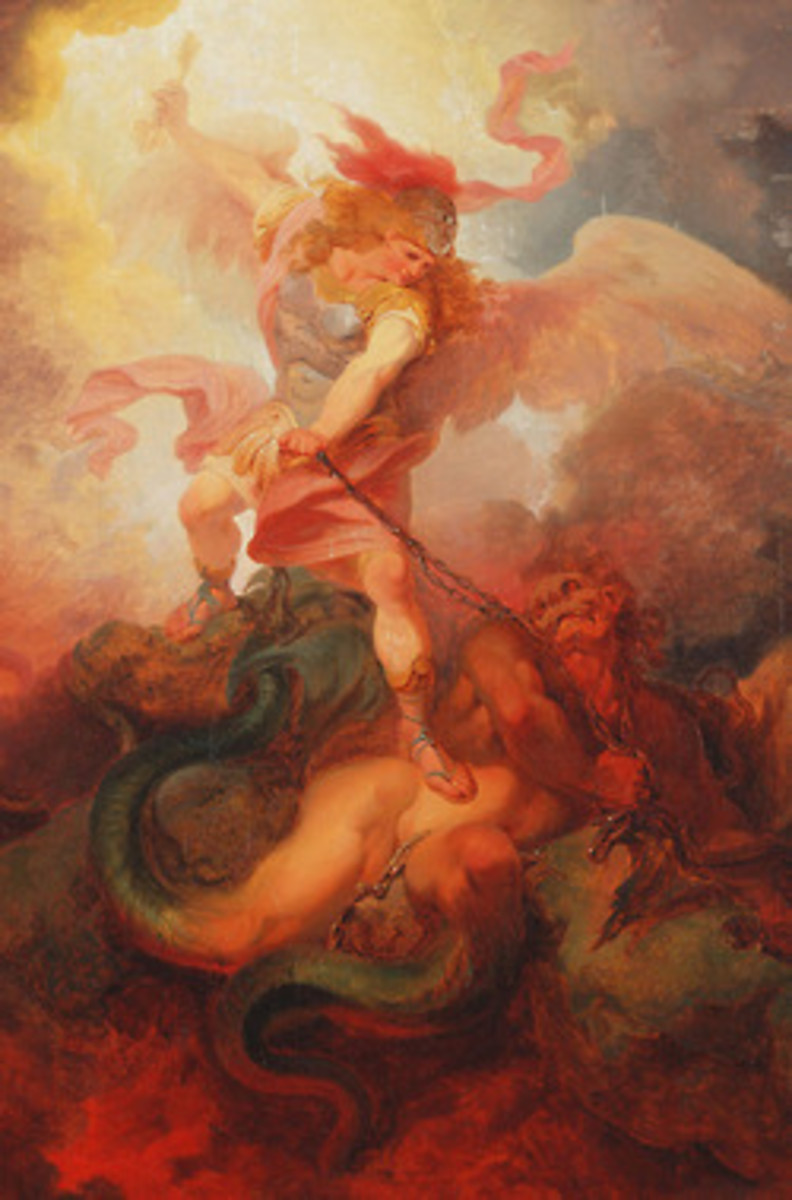
The Angel Binding Satan  - Philippe-Jacques de Loutherbourg  (31 October 1740 – 11 March 1812)-  an English painter of French origin.


The Angel Binding Satan - Philippe-Jacques de Loutherbourg (31 October 1740 – 11 March 1812)- an English painter of French origin.

Answering the Great Objection

While, in this short article we cannot answer all questions and objections to the subject of a figurative one-thousand year reign of Christ, we can, and should address the most common one. The most common question, or objection, to the view that I have just presented is this: “If the church age is the millennial reign of Christ how is it that Satan is bound?”
Of course, this question comes from Revelation 20:2-3, were John informs his readers that during the thousand years, of the Messiah’s rule, Satan would be bound. Considering the wickedness that has been recorded in the last two millennia, it is difficult for one to understand how it is that the “great Dragon” could have been bound all this time.
The first thing we need to recognize is that the “binding” is a qualified “binding.” Although the metaphors of a “chain,” and “seal” are used, one is warned against taking these items too literally; after all, this is a book of symbols. John tells his readers (in Revelation 20:2) that the “binding” was to restrain Satan from deceiving the nations “till the thousand years should be fulfilled.” Therefore, the “seal” placed upon him was a prohibition from hindering the spread of the Gospel of the Kingdom. This binding is, most likely, referenced by the apostle Paul when he wrote to the church at Thessalonica: “And now ye know what withholdeth that he might be revealed in his time. For the Mystery of iniquity doth already work: only he who now letteth (restrains) will let (restrain), until he be taken out of the way. And then shall that Wicked be revealed, whom the Lord shall consume with the spirit of his mouth, and shall destroy with the brightness of his coming.” (2 Thessalonians 2:6-8).
No doubt, it is this very restraint that is spoken of by Christ in Mark 3:26, where he said: “No man can enter into a strong man’s house, and spoil his goods, except he will first bind the strongman: and then he shall spoil his house.” Jesus had, indeed, entered into Satan’s house (see Matthew 4:1-11 where Satan demonstrates his authority over the earth) and was prepared to spoil it. Also, the language of Luke 10:18 and 11:20-22 represents the Messiah restraining the devil to take his goods:
  • Luke 10:18 Jesus says: “I beheld Satan as lightning fall from heaven.”
  • Luke 11:20-22, Jesus says: “But if I with the finger of God cast out devils, nodoubt the kingdom of God is come unto you. When a strongman armed keepeth his palace, his goods are in peace: But when a stronger then he shall come upon him, and overcome him, he taketh from him all his armor wherein he trusted, and divideth his spoils.”
From these words of Jesus we may be assured that Satan has been bound, cast down, and overcome so that the kingdom of the Messiah can be established.
Dear friends, having set forth what the Bible teaches about the thousand year reign of Christ and the binding of Satan during this time, it is my prayer that you have been equipped to better see your position within the kingdom of the Messiah. Christ calls us to work while it is today, for night comes when Satan will be released from his restraints to re-deceive the nations and come against the “Camp of the Saints”(Revelation 20:9). While he is restrained we must strike at his kingdom and spoil his goods for the advancement of the Messianic Mission.
May the God of all love keep you all in His grace, is my prayer for all of you.

Apostolically Speaking
☩ Jerry L Hayes

Dr Ralph E. Bass On Revelation 20:1-6

Read other essays from the Bishop on Apostolic Kingdom Theology at the links provided here:


You Would Enjoy Reading This Book by Bishop J L Hayes


Letters to my Children on Apostolic Kingdom Theology: An Apostolic Answer to Dispensationalism Concerning the Mission of the Lord's Church and End-Time Events
After spending over forty years in the dispensational doctrine, and having raise my children in that theological framework, I became a convinced adherent to a "kingdom" theology that recognizes the Church as the Israel of God, and that the first century actually saw the fulfillment of most of Matthew chapter 24. "Letters to My Children on Apostolic Kingdom Theology" is a compilation of twenty four letters written to my children explaining my journey, and showing how we were led astray from the apostolic teaching of Scripture to embrace a view recently come into the Lord's church, of which the apostles knew nothing. These "Letters" provide a systematic approach to Apostolic Eschatological study of Scripture. It is sure to interest all students of Scriptures.


Be sure to listen and subscribe to the Bishop's Podcast: Apostolic Bishop, at:


Monday, July 15, 2019

OLD TESTAMENT PLURALS (Answering Objections to Modalism)


The Pluralists’ Objection
The Pluralists feel that in the plural pronouns of the Old Testament (Gen 1:26; 11:7 and Isa 6:8) they have found an indication of a plurality of persons within the Godhead. In this chapter we will deal with each of these three passages in turn.
  1. Genesis 1:26 
“And God said, Let us make man in our image, after our likeness: and let them have dominion over the fish of the sea, and over the fowl of the air, and over the cattle, and over all the earth, and over every creeping thing that creepeth upon the earth.”
According to the teaching of the Pluralists, the plural pronouns “us” and “our” in this text prove that God is more than one person. According to this line of reasoning, it is Father God who is speaking to the other two persons of the Godhead (if one is a Trinitarian). So, God the Father says to God the Son, and to God the Holy Spirit “Let Us make man in Our image, and after Our likeness.” If the Pluralist is an Arian or Binitarian, then one sees the Father speaking to the Son.

Modalism’s Response
The Trinitarian Dilemmas
There are many problems created by this line of reasoning, the least of which is not the very next verse in the passage.
“So God created man in his own image, in the image of God created he him; male and female created he them” —Genesis 1:27.

In v27 God is referenced by the single pronouns “his” and “he.” So, then, the same argument which would make God a plurality of persons in v26, because of the plural pronouns, would make Him a single person in v27, by virtue of the single pronouns. Consistency is a virtue that the Pluralists’ dogma cannot afford. To remain consistent with the evidence of the number of the pronouns, there is a stalemate produced between vv26 and 27. That is to say: One cannot argue that the plural pronouns of v26 prove a plurality of persons, if one is not prepared to argue that the single pronouns of v27 prove a single solitary person. Since neither Trinitarianism, Binitarianism nor Arianism are prepared to be consistent with their “pronoun” argument, the weakness of their position becomes apparent.

A more serious dilemma is created by the Pluralists’ interpretation of Genesis 1:26, in that God the Father is given accomplices in creation. We see the predicament created by this when Isaiah 44:24 is presented: “I am the LORD that maketh all things; that stretcheth forth the heavens alone; that spreadeth abroad the earth by myself.” Here, Yahweh (“LORD” in all caps) states clearly that He alone made the heavens and the earth. Now, according to Trinitarian, Binitarian and Arian dogma, He did not do it alone, but the “Us” were present to assist Him. If there were an “Us” participating in the act of creation, then Isaiah must be misquoting Yahweh. Or, Yahweh is taking credit for work that He did not do alone, in which case He would be lying. Of course, we know the truth: Yahweh created all things by Himself, without the aid or assistance of anyone else. Therefore, the Pluralistsʼ interpretation of Genesis 1:26 is in error, and another understanding must be sought.

The Solution — Plurality of Majesty
According to Isaiah 44:24 there is one single creator of all things in heaven and earth: “I am the LORD that maketh all things; that stretcheth forth the heavens alone; that spreadeth abroad the earth by myself.” Notice the words in this text” “I, “alone,” and “myself.” There are no accomplices recognized here. The quandary presented by Genesis 1:26 and Isaiah 44:24 is solved when one considers Ephesians 1:11, “In whom also we have obtained an inheritance, being predestinated according to the purpose of him who worketh all things after the counsel of his own will:” Amazing!

From Paulʼs letter to the Ephesians we are told that God “worketh all things” after counseling with His own will. In Genesis 1:26 Yahweh is counseling with someone, this is true. The question is: Who? Whomever Yahweh is counseling with took part in the creation of mankind. Since we have a clear testimony from Yahweh Himself (Isaiah 44:24), that He alone created, we must conclude that: If Yahweh counseled with anyone concerning creation, it would have been Himself. Interestingly enough, this is exactly the Apostle Paulʼs understanding; for, he wrote to the Ephesians that God created after taking counsel with Himself. So, then, the question: To whom was God speaking in Genesis 1:26 (when he said: “let us make man”) would be answered by Ephesians 1:11, where it is stated that He was counseling with His own will. If one is unhappy with the phrase "Plurality of Majesty" then I might say that the Hebrew divines favored a "Plural of Self-Deliberation”; which, to me, amounts to the same thing.  Just Amazing!

The plural pronouns employed by Yahweh is a common usage of speech among monarchs and rulers. This is called the Plurality Of Majesty. The majestic status of a king is far above that of his subjects, so much so, that a king may commonly speak of himself in the plural, thus, the Plurality of Majesty.

Examples of the Plurality of Majesty may be seen in many places throughout Scripture; but, especially, in Ezra 4:11ff and Daniel 2:36. In the book of Ezra 4:11-18 we read the narrative of a letter being sent to king Artaxerxes. In v11 the prophet Ezra writes the following: “This is the copy of the letter that they sent unto him, even unto Artaxerxes the king.” Then in v18 the King is speaking concerning the letter and states: “the letter which ye sent unto us...” in this case the Plurality of Majesty is demonstrated, in that the king refers to himself in the plural. Another example is Daniel 2:36. In this passage Daniel refers to himself in the plural, when he comes before Nebuchadnezzar, to tell the king of the dream and its interpretation. Daniel said, “This is the dream; and we will tell the interpretation before the king.” Notice that Daniel says: “WE will tell...” In this place Daniel employs the Plurality of Majesty in reference to himself.

As we return to the passage in question (Genesis 1:26 and 27) an interesting point should be made; namely, in v26 God is speaking of Himself, while in v27 God is being spoken about. In other words, in v26 God speaks in the first person, in the Plurality of Majesty; while in v27 God is spoken of in the third person singular. This would be quite natural, if the Plurality of Majesty is the correct understanding. Although Moses recorded the words of Yahweh with the plural pronouns, he did not have the understanding that these plural pronouns indicated plural persons; for when he gave commentary on the words of Yahweh, he used single pronouns for God. Moses understood the Plurality of Majesty; so that when he gave commentary on the words of Yahweh, he wrote, “So God created man in his own image, in the image of God created he him, male and female created he them.” The important point to note here, is that God is never referenced with plural second or third person pronouns such as “Ye” (You all) or “Their.” When plural pronouns are used for God it is always when He is referencing Himself, thus, the Plurality of Majesty.

  1. Genesis 11:7 
“Go to, let us go down, and there confound their language, that they may not understand one anotherʼs speech.” 
According to Trinitarian Pluralists, the LORD (Yahweh) is speaking to the other two persons of the Trinity, or, if Arian or Binitarian (those who believe in two persons), to the Son.
Modalism’s Response
The Pluralists, whether they be Trinitarian, Binitarian or Arian, defeat themselves with this line of reasoning. And this is how: The word “LORD,” from v6, is in all capital letters: which means it is the Tetragramaton (the four letters YHWH, which stand for the name of God).
  1. Notice, then, that Yahweh says; “Let Us...”
  2. If the Pluralists are correct, Yahweh is speaking to OTHERS.
  3. Since they (especially the Trinitarian) believe Yahweh is the group name of the Father, Son, and Holy Spirit, they defeat their own argument.
We say that the Pluralists defeat their own argument in this line of reasoning, because those spoken to would, of necessity, not be Yahweh: the preceding verse said “And the LORD (Yahweh) said,...” So the LORD (Yahweh) said to others, who are not, themselves, Yahweh, “Let us go down...”
Depending upon the school of Pluralists in this discussion, Yahweh is either the group name of the Father, Son and Holy Spirit, or the name of God the Father. Either way, the argument of plurality of persons within the Godhead being proven by the plural pronouns defeats itself. Either Yahweh (Father, Son and Holy Spirit) is speaking to the Angels (or a multitude of other ideas) who are not Yahweh; or Yahweh, the Father, is speaking to the Son and/or the Holy Spirit, who are not Yahweh. The weight of this is felt when we discover: If one is not Yahweh, then not God. This is made clear from the following texts: 
  • Exodus 6:3 “And I appeared unto Abraham, unto Isaac, and unto Jacob, by the name of God Almighty; but by my name JEHOVAH (Yahweh) was I not known to them.” 
  • Deuteronomy 6:4 “Hear, O Israel; The LORD our God is one LORD:” (Hebrew: The Yahweh our Elohim is one Yahweh.)
Either way, whether Yahweh is speaking to angels or speaking to the Son and/or the Holy Spirit (who are not Yahweh) Trinitarianism, Binitarianism, Arianism, and like minded isms, are defeated by their own argument, in that other persons of the Godhead are not found here.

The plain truth of this narrative is this: Only one came down to see the work of manʼs hands (Genesis 11:8). The one that did come and scattered man upon the face of the earth was Yahweh Himself. Where were the “Us?” The answer is: they were never there. God counsels with His own will, according to Ephesians 1:11, “In whom also we have obtained an inheritance, being predestinated according to the purpose of him who worketh all things after the counsel of his own will:”  

From whom would the God of all the universe seek counsel? Who would be His equal that He would value his, or her, opinion? This is another example of Yahweh speaking of Himself in the plural, to show power and majesty. This use of language is called the Plurality of Majesty (also called the Plurality of Plentitude) and is seen in Genesis 1:26; Daniel 2:36; Ezra 4: 11, 18.

III. Isaiah 6:8 
“Also I heard the voice of the Lord, saying, whom shall I send, and who will go for us?”
Again, those who wish to find “persons” in the Godhead point to this passage as a proof text. Here, they hope to find their persons of  Trinitarianism, and/or Binitarianism, and/orArianism , etc.

Modalism’s Response:
This passage from Isaiah is of a different nature than the plural pronoun passages from Genesis 1:26 and 11:7, which we have reviewed in our preceding comments. We say that this passage from Isaiah is different, because in Genesis 1:26 and 11:7, God speaks of Himself in the plural; however, here, in Isaiah 6:8, God speaks of Himself in the singular and uses the word “I.” Notice, that when Isaiah quotes the words of the LORD he says that the LORD said “Whom shall I send, ...”
When one observes the law of context (which one must), we discover the following things from this passage: 
  1. There is one speaker; 
  2. The terms “I,” and “us,” are in the same statement;  
  3. The “us” must mean the LORD and others.
By looking at the context of the Scripture under consideration we must ask, “Who are the ʻUS?ʼ” Of course the Bible is clear in giving the answer to our question, “Who are the ʻUSʼ?” The answer is found in Isaiah 6: 1-2, which is the introduction to our narrative.
“In the year that king Uzziah died I saw also the LORD sitting upon a throne, high and lifted up, and his train filled the temple. Above it stood the seraphims: each one had six wings; with twain he covered his face, and with twain he covered his feet, and with twain he did fly.” (Isaiah 6:1-2).

In these two verses the “Us” are identified as: 
1. The LORD (YHWH),
2. His train (His following),
3. The Seraphim.


I might be so bold, at this point, to venture an explanation as to why such a statement was made, or such a question would be asked by Yahweh. Just why did Yahweh ask, “Whom shall I send, and who will go for us?” The answer is twofold: First, to show the benefactor as Yahweh Himself, for He asked, “Whom shall I send... .” Only one is sending in power and might (Ps 62:11; 65:6; 121:1-8). Second, to show the beneficiary, for Yahweh asked: “Who will go for us?” Therefore the benefactor sends the sent in behalf of all of Heaven: the “Us.” (See, 1 Cor 6:3; 1 Pet 1:12; Heb 12:22.) So, then, in Isaiah 6:8, Yahweh sent Isaiah the prophet to preach to the world in behalf of the “Us:” namely, those who inhabit heaven, i.e. the train (those who follow the King) and the Seraphim.

There are no plurality of persons in the Godhead seen in this passage, or in any other plurals of the Old Testament. The smoke and mirrors that have been used for centuries by the Pluralist theologians, of all stripes, are but tools of religious prevaricators, to lead astray those who do not care enough to vet their claims.

Apostolically Speaking;
☩☩ Jerry L Hayes
(Mar David Ignatius)


Be sure to listen and subscribe to the Bishop's Podcast: Apostolic Bishop, at:


Read other Essays from the pen of the Bishop on the subject of the Godhead:

"The Worlds, Made By The Son"
https://bishopjerrylhayes.blogspot.com/2012/10/the-worlds-made-by-son.html

"Hebrews 13:8 vs 1 Corinthians 15:28"
https://bishopjerrylhayes.blogspot.com/2012/12/hebrews-138-vs-1-corinthians-1528.html

"Glory With The Father"
https://bishopjerrylhayes.blogspot.com/2012/12/glory-with-father.html

"Philippians 2:6-8, Answering Trinitarian Objections"
https://bishopjerrylhayes.blogspot.com/2013/02/philippains-26-8-answering-trinitarian.html

"How Is God One?"
https://bishopjerrylhayes.blogspot.com/2013/02/how-is-god-one.html

"Hebrew Monotheism"
https://bishopjerrylhayes.blogspot.com/2013/02/hebrew-monothesim.html

"An Exegesis of 1 Corinthians 8:6-7"
https://bishopjerrylhayes.blogspot.com/2013/02/an-exegesis-of-first-corinthians-86-7.html

"Answering Trinitarian Objections To The Oneness Faith"
https://bishopjerrylhayes.blogspot.com/2013/03/answering-trinitarian-objections-to.html


"The Apostolic Creed"
https://bishopjerrylhayes.blogspot.com/2013/05/i-believe-in-one-god-1-solitary-in.html

"Jesus Is Father God"
https://bishopjerrylhayes.blogspot.com/2013/07/jesus-is-father-god.html

"Homoousia And The Creed Of Nicaea"
https://bishopjerrylhayes.blogspot.com/2013/10/homoousia-and-creed-of-nicaea.html

"The Triquetra And Modalism"
https://bishopjerrylhayes.blogspot.com/2013/12/triquetra-and-modalism.html

"Modalism, Simultaneous Or Sequential?"
https://bishopjerrylhayes.blogspot.com/2014/01/modalism-biblical-and-historical.html

"Micah 5:2-4, An Exegesis"
https://bishopjerrylhayes.blogspot.com/2014/02/micah-52-4-exegesis-but-thou-bethlehem.html


"Elohim, the Plural form For God"
https://bishopjerrylhayes.blogspot.com/2014/10/answering-trinitarian-objections-to.html

"Can the Deity of Jesus Be called The Son Of God?"
https://bishopjerrylhayes.blogspot.com/2015/04/can-deity-of-jesus-be-called-son-of-god.html

"Mathematical Equation For The Godhead"
https://bishopjerrylhayes.blogspot.com/2015/04/mathematical-equation-of-godhead-1x1x11.html

"Hebrew Monotheism, Second Edition"
https://bishopjerrylhayes.blogspot.com/2015/05/hebrew-monotheism.html

"Jesus, On God's Right Hand"
https://bishopjerrylhayes.blogspot.com/2015/05/jesus-on-gods-right-hand.html

"The Name of the Deity" (The Tetragrammaton)
https://bishopjerrylhayes.blogspot.com/2015/05/the-name-of-deity-tetragrammaton.html

"Christology of the Apostolic Church Fathers"
https://bishopjerrylhayes.blogspot.com/2015/06/christology-of-apostolic-church-fathers.html

"Christian Modalism challenged by the Greeks"
https://bishopjerrylhayes.blogspot.com/2015/06/christian-modalism-challenged-by-greeks.html

"The Apologists and the Logos Christology"
https://bishopjerrylhayes.blogspot.com/2015/06/the-apologist-and-logos-christology.html

"Logos Christology"
https://bishopjerrylhayes.blogspot.com/2015/06/logos-christology.html

"The Seven Spirits of God"
https://bishopjerrylhayes.blogspot.com/2015/07/revelation-14-apostolically-speaking.html

"Historical Numerical Superiority of the Monarchians"
https://bishopjerrylhayes.blogspot.com/2015/07/the-historical-numerical-superiority-of.html

"How Is God One?" Second Edition
https://bishopjerrylhayes.blogspot.com/2015/07/how-is-god-one.html

"Creed of Nicæa (Creed of the 318) Affirmed"
https://bishopjerrylhayes.blogspot.com/2015/09/creed-of-nica-creed-of-318-affirmed.html

"Another Comforter (Answering Objections to Modalism)"
https://bishopjerrylhayes.blogspot.com/2015/09/another-comforter-answering-objections.html

"Echad vs Yachid (Answering Objections to Modalism)"
https://bishopjerrylhayes.blogspot.com/2015/09/echad-vs-yachid-answering-objections-to.html

"The Godhead Teaching of Ignatius of Antioch"
https://bishopjerrylhayes.blogspot.com/2015/10/godhead-theology-of-bishop-ignatius-of.html

"Hebrews 1:8, (Answering Objections to Modalism)"
https://bishopjerrylhayes.blogspot.com/2015/10/godhead-theology-of-bishop-ignatius-of.html

"Godhead Theology of the Tabernacle of Moses"
https://bishopjerrylhayes.blogspot.com/2016/08/godhead-theology-of-tabernacle-of-moses_5.html

"Proper Biblical Understanding of the Word 'Person'"
https://bishopjerrylhayes.blogspot.com/2017/04/proper-biblical-understanding-of-word.html

"Defense of Isaiah 9:6, Answering Objections to Modalism"
https://bishopjerrylhayes.blogspot.com/2017/04/defense-of-isaiah-96.html


Defense of 1 Timothy 3:16 (Answering Objections to Modalism)
http://bishopjerrylhayes.blogspot.com/2019/06/defense-of-first-timothy-316-answering.html


Godhead Theology is a study of Christian Godhead theology. ... Was He God or not? In Godhead Theology Bishop Jerry Hayes follows that debate through the first 300 years of the Church's history. Our book is in five sections: Section One ... demonstrates Modalistic Monarchianism as the original orthodoxy of the Chruch; Section Two introduces the Apostolic Creed ... ; Section Three is an affirmation of Modalistic Monarchianism; Section Four is Modalism's responses to objection from the pluralists Trinitarians, Binitarians, Arians and Semi-Arians. Included are two comprehensive indexes: Subject Index and Scripture Index. 613 pages.

Own this classic book today by ordering from the link provided here:
https://www.amazon.com/Godhead-Theology-Modalism-Original-Orthodoxy/dp/1516983521/ref=sr_1_4?keywords=Bishop+Jerry+hayes&qid=1554244653&s=books&sr=1-4


The Jesus Debate is a written debate between Bishop Jerry Hayes and Prof. Willy Olmo. This book contains all papers submitted between this two knowledgeable men. Bishop Hayes affirms and defends the Oneness of God; Prof. Olmo affirms and defends Arian Unitarianism.

Own this classic debate by ordering from the link provided here:
https://www.amazon.com/Jesus-Debate-Modalism-Arianism-Unitarianism/dp/1484036670/ref=sr_1_6?keywords=Bishop+Jerry+hayes&qid=1554244653&s=books&sr=1-6


The Hayes vs Mulbah Debate is a formal written debate on the subject of the Godhead, between Bishop Jerry L Hayes (Onenessarian) and Minister Andrew Mulbah (Trinitarian). This work contains the debate in its entirety plus other related material. Included are the two Creeds from which both disputants argue their respective views: The Apostolic Creed (the statement of faith for the Oneness/Modalistic Monarchian theology) and the Athanasian Creed (the official statement of faith for the Trinitarian theology).

Own this remarkable debate today, by ordering it from the link provided here:
https://www.amazon.com/Hayes-Mulbah-Debate-Oneness-Trinity/dp/1727358953/ref=sr_1_8?keywords=Bishop+Jerry+hayes&qid=1554244653&s=books&sr=1-8


THANK YOU FOR YOUR SUPPORT BY

PURCHASING OUR BOOKS OF YOUR LIBRARY


Be sure to listen and subscribe to the Bishop's Podcast: Apostolic Bishop, at: