 |
| Bishop Jerry L Hayes |
“Liturgy and Liturgical Vestments,” apart from being the title of this essay, are three words not often heard in Pentecostal circles. The reason for that is they are old words and we are a new church, as church communities go. Yes, we are the revival of the first-century apostolic church that was founded on the Day of Pentecost A.D. 30 as is proven by our church doctrine (dogma); however, the key word in that last statement is “revival”. During the long centuries (5th—20th) of the “falling away” prophesied about by Apostle Paul (2 Thessalonians 2:1-3) many things were lost to our memory: these three words (“Liturgy and Liturgical Vestments,”) were among those things. Because these words sound strange to us, some, if not most, will think they are not biblical words and have no place in our church language; but, nothing could be further from the truth. The purpose of this essay is to reintroduce these three words and their meaning and how they should be welcomed back into our language and church-craft.
The word “liturgy” means: divine public service; it is found in our Bibles in the following passages: John 16:2, Romans 9:4, 12:1, Hebrew 9:1. This sounds strange to us because it is the Greek word, litreia. The New Testament was originally written in the Greek language because it was the lingua franca of that time period, just as English is today. So, the early Christians, who were our forbearers in the faith, used the word “litreia” in their daily conversation to reference public worship services. This word comes into English as “liturgy”. So, when we, as twenty-first-century Christians, speak of the “liturgy” we are speaking of the public worship service. And when we use the word “liturgical” we are speaking of any practice or item associated with said public worship. When we speak of “liturgical vestments” it is the sanctioned apparel worn by those officiating the public service.
Pentecostal Liturgy and Liturgical Apparel?
I would ask the reader to pause and consider, with me, at this point both the liturgy and liturgical vestments (apparel) sanctioned in Pentecostal churches throughout the world, but especially in America. As far as Pentecostal liturgy is concerned: The order of public worship is the same the world over: Prayer, singing, prayer request, testimony, choir or special singing and preaching (generally speaking)— dismissal. Up until the advent of pop-culture Christianity it was deemed improper for any man or woman to be on the platform without being dressed in business attire (some Pentecostal churches insist on white shirts only on the platform).
So, then, Pentecostals have always had both a liturgy and liturgical garments (of a fashion). So, what I am writing about is not all that strange to us, when we think about it.
A Biblical Practice
Some may think that clerical garments such as the clergy shirt with the collar and the cassock, and the liturgical vestments such as the robes and stoles along with the different colors associated with the ecclesiastical calendar year are unnecessary, if not unbiblical.
The Lord’s church has followed the church of the Old Covenant (in principle) in both her liturgy and liturgical vestments (garments). Bearing in mind that Christianity is the fruition of Judaism, and not its replacement, and further, bearing in mind that Yahweh Himself decreed that the ministers of His church in the Old Testament have a liturgy; so, then, to be vested in liturgical garments is a natural (and biblical) process for the New Covenant church.
Read Yahweh’s instruction for the vesting of His priest:
Exodus 28:2-8
And thou shalt make holy garments for Aaron thy brother for glory and for beauty. 3. And thou shalt speak unto all that are wise hearted, whom I have filled with the spirit of wisdom, that they may make Aaron's garments to consecrate him, that he may minister unto me in the priest's office. 4. And these are the garments which they shall make; a breastplate, and an ephod, and a robe, and a broidered coat, a mitre, and a girdle: and they shall make holy garments for Aaron thy brother, and his sons, that he may minister unto me in the priest's office.
5. And they shall take gold, and blue, and purple, and scarlet, and fine linen. 6. And they shall make the ephod of gold, of blue, and of purple, of scarlet,and fine twined linen, with cunning work. 7. It shall have the two shoulderpieces thereof joined at the two edges thereof; and so it shall be joined together. 8. And the curious girdle of the ephod, which is upon it, shall be of the same, according to the work thereof; even of gold, of blue, and purple, and scarlet, and fine twined linen.
Exodus 28:37
And thou shalt put it on a blue lace, that it may be upon the mitre; upon the forefront of the mitre it shall be.
Exodus 28:39
And thou shalt embroider the coat of fine linen, and thou shalt make the mitre of fine linen, and thou shalt make the girdle of needlework.
Exodus 29:6
And thou shalt put the mitre upon his head, and put the holy crown upon the mitre.
Exodus 39:1ff
And of the blue, and purple, and scarlet, they made cloths of service, to do service in the holy place, and made the holy garments for Aaron; as the Lord commanded Moses.
2 And he made the ephod of gold, blue, and purple, and scarlet, and fine twined linen. 3 And they did beat the gold into thin plates, and cut it into wires, to work it in the blue, and in the purple, and in the scarlet, and in the fine linen, with cunning work. 4 They made shoulderpieces for it, to couple it together: by the two edges was it coupled together. 5 And the curious girdle of his ephod, that was upon it, was of the same, according to the work thereof; of gold, blue, and purple, and scarlet, and fine twined linen; as the Lord commanded Moses.
6 And they wrought onyx stones inclosed in ouches of gold, graven, as signets are graven, with the names of the children of Israel. 7 And he put them on the shoulders of the ephod, that they should be stones for a memorial to the children of Israel; as the Lord commanded Moses.
8 And he made the breastplate of cunning work, like the work of the ephod; of gold, blue, and purple, and scarlet, and fine twined linen. 9 It was foursquare; they made the breastplate double: a span was the length thereof, and a span the breadth thereof, being doubled. 10 And they set in it four rows of stones: the first row was a sardius, a topaz, and a carbuncle: this was the first row. 11 And the second row, an emerald, a sapphire, and a diamond. 12 And the third row, a ligure, an agate, and an amethyst. 13 And the fourth row, a beryl, an onyx, and a jasper: they were inclosed in ouches of gold in their inclosings. 14 And the stones were according to the names of the children of Israel, twelve, according to their names, like the engravings of a signet, every one with his name, according to the twelve tribes. 15 And they made upon the breastplate chains at the ends, of wreathen work of pure gold. 16 And they made two ouches of gold, and two gold rings; and put the two rings in the two ends of the breastplate. 17 And they put the two wreathen chains of gold in the two rings on the ends of the breastplate. 18 And the two ends of the two wreathen chains they fastened in the two ouches, and put them on the shoulderpieces of the ephod, before it. 19 And they made two rings of gold, and put them on the two ends of the breastplate, upon the border of it, which was on the side of the ephod inward. 20 And they made two other golden rings, and put them on the two sides of the ephod underneath, toward the forepart of it, over against the other coupling thereof, above the curious girdle of the ephod. 21 And they did bind the breastplate by his rings unto the rings of the ephod with a lace of blue, that it might be above the curious girdle of the ephod, and that the breastplate might not be loosed from the ephod; as the Lord commanded Moses.
22 And he made the robe of the ephod of woven work, all of blue.
23 And there was an hole in the midst of the robe, as the hole of an habergeon, with a band round about the hole, that it should not rend. 24 And they made upon the hems of the robe pomegranates of blue, and purple, and scarlet, and twined linen. 25 And they made bells of pure gold, and put the bells between the pomegranates upon the hem of the robe, round about between the pomegranates; 26 A bell and a pomegranate, a bell and a pomegranate, round about the hem of the robe to minister in; as the Lord commanded Moses.
27 And they made coats of fine linen of woven work for Aaron, and for his sons, 28 And a mitre of fine linen, and goodly bonnets of fine linen, and linen breeches of fine twined linen, 29 And a girdle of fine twined linen, and blue, and purple, and scarlet, of needlework; as the Lord commanded Moses.
Leviticus 6:10
And the priest shall put on his linen garment, and his linen breeches shall he put upon his flesh, and take up the ashes which the fire hath consumed with the burnt offering on the altar, and he shall put them beside the altar. 11 And he shall put off his garments, and put on other garments, and carry forth the ashes without the camp unto a clean place.
Leviticus 8:13
And Moses brought Aaron's sons, and put coats upon them, and girded them with girdles, and put bonnets upon them; as the Lord commanded Moses.
Ezekiel 42:14
When the priests enter therein, then shall they not go out of the holy place into the utter court, but there they shall lay their garments wherein they minister; for they are holy; and shall put on other garments, and shall approach to those things which are for the people.
Ezekiel 44:17-19
And it shall come to pass, that when they enter in at the gates of the inner court, they shall be clothed with linen garments; and no wool shall come upon them, whiles they minister in the gates of the inner court, and within. 18, They shall have linen bonnets upon their heads, and shall have linen breeches upon their loins; they shall not gird themselves with any thing that causeth sweat. 19. And when they go forth into the utter court, even into the utter court to the people, they shall put off their garments wherein they ministered, and lay them in the holy chambers, and they shall put on other garments; and they shall not sanctify the people with their garments.
Liturgical vestments were prescribed by God, for the priesthood at its inception. They are commanded by God, to be holy beautiful, colorful, and made of fine cloth and with precious stones and gold. At no point in the Bible are vestments prohibited — only commanded.+
Lest some would object, to my referencing the priests of the Old Covenant, by suggesting that New Covenant ministers are not priests, I would point out that the prophet Malachi and the blessed Apostle Paul disagree. Malachi clearly prophesied the future universality of the priesthood: “For from the rising of the sun even unto the going down of the same my name shall be great among the Gentiles; and in every place incense shall be offered unto my name, and a pure offering: for my name shall be great among the heathen, saith the Lord of hosts.” (Malachi 1:11). In the following text the apostle Paul demonstrates the accuracy of Malachi’s prophecy by letting his readers know that he sees himself as a New Covenant priest: “But I have written very boldly to you on some points so as to remind you again, because of the grace that was given to me from God, 16 to be a minister of Christ Jesus to the Gentiles, ministering as a priest the gospel of God, so that my offering of the Gentiles may become acceptable, sanctified by the Holy Spirit. 17 Therefore in Christ Jesus I have found reason for boasting in things pertaining to God.” (Romans 15:15-17, NASB). “Ministering as a priest”: the Greek word is hierourgeo: Strong’s Concordance defines it as “to be a temple-worker, i.e., officiate as a priest (fig.): — minister.” This classic reference work states: “to minister in the manner of a priest, minister in priestly service.” It also notes (from Joseph Thayer’s Greek-English Lexicon) historical etymological definitions of “to be busied with sacred things; to perform sacred rites” (from Philo), and “used esp. of persons sacrificing” (from Josephus). Baptist Greek scholar A. T. Robertson, in his famous work, Word Pictures of the New Testament (Nashville, Tennessee: Broadman Press, 1930; six volumes; under Romans 15:16; vol. 4, 520), provides the basic definition: “to work in sacred things, to minister as a priest.” Likewise, Marvin Vincent’s Word Studies in the New Testament (four volumes; New York: Charles Scribner’s Sons, 1887; reprinted: Grand Rapids, Michigan: Wm. B. Eerdmans Publishing Co., 1946; vol. III, 174) states, for the same passage: “Ministering (ierourgounta). Only here in the New Testament. Lit., ministering as a priest.”
In support of a New Testament church liturgy and liturgical vestments we should consider James’ reference to the church as the “Tabernacle of David”: “Men and brethren, hearken unto me: Simeon hath declared how God at the first did visit the Gentiles, to take out of them a people for his name. And to this agree the words of the prophets; as it is written, After this I will return, and will build again the tabernacle of David, which is fallen down; and I will build again the ruins thereof, and I will set it up: That the residue of men might seek after the Lord, and all the Gentiles, upon whom my name is called, saith the Lord, who doeth all these things.” (Acts 15:13-17, cf Amos 9:11-12). That the Lord’s church is, indeed, the Tabernacle of David that has been rebuilt is sure and certain evidence that the true church is a liturgical community. This is asserted on the strength that King David was the architect of Israel's liturgy. It was David that raised up a tabernacle in Jerusalem into which he placed the Ark of the Covenant. He assigned Levites to attend the Ark in song, instruments of music, and prayers continually. He ordered the Levites into courses and appointed the vestments for them. Centuries later when the Jews returned from the Babylonian captivity and temple worship was being reestablished under the leadership of Zerubbabel, when the foundation of the Second Temple were laid, we read: “And when the builders laid the foundation of the temple of the Lord, they set the priests in their apparel with trumpets, and the Levites the sons of Asaph with cymbals, to praise the Lord, after the ordinance of David king of Israel.” (Ezra 3:10). According to James, the Lord’s half brother, the church is “that” system reconstructed around the Cross of Christ.
The Priestly Garments of Christ
The garments of Christ are not to be ignored on this account. The Gospels inform us that often times the sick and infirm touched His garments and were made whole. The words of the prophet Ezekiel references the anointing in the very garment of the priests: “And when they go forth into the utter court, even into the utter court to the people, they shall put off their garments wherein they ministered, and lay them in the holy chambers, and they shall put on other garments; and they shall not sanctify the people with their garments.” (Ezekiel 44:19). A clue to the power of Jesus’ garment to heal is given by the apostle John, who, alone of the Gospel writers, records the parting of Jesus’ garments among the soldiers that crucified Him: “Then the soldiers, when they had crucified Jesus, took his garments, and made four parts, to every soldier a part; and also his coat: now the coat was without seam, woven from the top throughout.” (St. John 19:23). Here, the term “coat” is the Greek chitōn, and is properly the tunic, or undergarment. It reached from the neck to the feet, while the outer “garment” was a square garment thrown round the body. Ordinarily the tunic consisted of two pieces connected at the shoulder by clasps; but that worn by Jesus was made in one piece. This was the rule with the priestly tunics. (Comp. the account of Aaron’s tunic in Josephus’ Antiquity of the Jews iii. 7, § 4.) So, this seamless undergarment which Christ worn identified Him with the priesthood, in fact as the true High Priest of the New Covenant.
The Priestly Garments of James
The Jewish Christian historian Hegesippus (A.D. 110-180) writes much of James, the Lord’s half brother and first bishop of Jerusalem. He states, as a matter of importance, that James were only linen garments. Now, the noteworthy reason for James’ garments being of linen, and Hegesippus’ mentioning of the fact, is the following: The ministerial priesthood only wore linen garments (Leviticus 8:7; Exodus 28:4, 39; 39:27). James wore linen as a sign of the new priesthood that he served as Christ's representative to the New Covenant people.
More Historical Evidence
In the two previous paragraphs we have noted the special garments of both Christ, the High Priest of our profession, and James, the first bishop of Jerusalem. For both individuals the garments link them to the priesthood. This should be convincing that priestly garments are appropriate for the Christian ministry. But there is more.
Hegesippus and the early Church historian Epiphanes, Eusebius, and Bishop Polycrates of Ephesus [circa A.D.125-196; who testifies that St. John the Apostle had been the Bishop of Ephesus] record that three Jewish-Christian bishops, James, Bishop of Jerusalem, Mark the Evangelist, Bishop of Alexandria, and the Apostle John, Bishop of Ephesus wore a plate on their miters similar to the sacerdotal plate worn by the Jewish High Priest: Epiphanes wrote of James that he wore "the shining plate (petalon lumina) of the Jewish high priest.". According to Exodus 39:30-31 the High Priest was required, as a sign of his holy office to wear a golden ban with the words: "consecrated to Yahweh." See Lev 8:7-9. [see Nicene and Post Nicene Fathers, volume1, page 163 & 242; Church History, Book III, chapter 31.3; Epistle of Irenaeus to Victor, XXIV.3; Epiphanius, Heresies, LXXVII.14; Polycrates quoted by Eusebius, Church History, III,3l1, V.24].
Dear friends, what this demonstrates is that the very first Apostolic Bishops of the Lord’s church practiced wearing liturgical vestments.
The Christian Altar And Its Priesthood
The New Testament is clear that the Christian liturgy (public worship service) centers around the Lord’s Table which the writer of Hebrews identifies as the Christian altar when he writes: “We have an altar, whereof they have no right to eat which serve the tabernacle.” (Hebrews 13:10.) Further, the New Testament is clear that the ordained ministry is the priesthood that serves at this Christian altar when the Church comes together “upon the first day of the week, … to break bread, …” (Acts 20:7); or, whenever believers “come together in the church” (1 Corinthians 11:18).
Summary
Because I wear the garments of a Christian minister, I am often asked if I am attempting to imitate the Roman Catholic Church. Of course my answer is a resounding NO !
I can tell by the way many ask that they do not approve. Sadly, however, they do not approve because they do not understand the things I have written about in this essay. If they are of the opinion that it is Roman Catholic attire, they would be mistaken.
The clerical attire is holy to me because it is holy unto the Lord. In our day when Christianity is so put down, I find it a witness for Christ. When I am about town, so to speak, no one mistakes me for a used car salesman, or a banker, lawyer or even a medical doctor, for that matter. In fact my appearance announces to all who see me that the Kingdom of God is open for business. According to Apostolic Orthodox protocol I am expected to wear clergy apparel whenever outside my home.
Although I do not have to defend clerical dress, I will say this in the spirit of brotherly love: I am happy to help educate the uneducated. Clerical dress is customary with the P.A.W. (Pentecostal Assemblies of the World), a major Oneness Pentecostal denomination. Much of my Pentecostal life has been spent in and with that group. I adopted my dress from them. Those who associate the collar with the RCC are un-knowledgeable. Trust me, if you, as a Pentecostal, are offended by my clerical garments, you are the only ones offended. It is respected by the world we are trying to reach with the gospel.
Here is a prediction: Just as we are beginning to see the term "Bishop" used among the Oneness Pentecostals where we never did before (except in the PAW), clergy garments such as the collar will be seen more and more over the next few decades.
As the Christian faith becomes more disliked and the more society attempts to push us into the shadows, the more our ministers will force our visibility by their apparel. it is an "In Your Face" kind of evangelistic move.
Clergy apparel is a personal decision I made which I felt would be pleasing to God. After studying the liturgical garments of the Old Testament and discovering that Jesus and the first bishops of the church wore such garments, I took up the apostolic custom and made it an essential element of my church-craft; and thus, the church-craft of the Apostolic Orthodox Church International.
In conclusion, we should mention that the prophet Elijah wore specific attire that made him recognizable by all who saw him, and the prophet John the Baptist dressed in the same exact way (2 Kings 1:8 cf Matthew 3:4//Mark 1:6). Historians report, as we have seen, that James the half brother of Christ and the Apostle John wore priests’ garments. And Jesus, Jesus did, indeed wear the garments of a religious teacher. And, O, there is this: The New Testament church is the "Tabernacle of David" rebuild -- according to James. It was in the establishing of the tabernacle of David that religious garments were assigned to everyone who served in the house of God (see above). So, then, Liturgy and Liturgical Vestments are very biblical. Christianity is not something else apart from Judaism, it is Judaism in full bloom.
Clerical attire has been present in the modern day apostolic movement from the very first as these pictures of Bishops David T. Schultz and Jerry L Hayes bear witness:
Bishop David T. Schultz, P.A.W. (1889 - 1972)

Bishop Jerry l Hayes, A. O. C. I. (1950 - Present)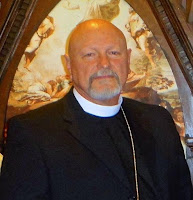
Apostolicaly Speaking,
☩ Jerry L Hayes


